By A.R. Hashir • Updated 1 November 2026 • Independent buyer guide for CEOs, CFOs and founders. The author’s related book is disclosed near the end. Educational information only—not legal, financial or hiring advice for a specific company.
Short answer: A fractional Chief AI Officer—usually shortened to fractional CAIO and sometimes marketed as a fractional AI officer, part-time Chief AI Officer or interim CAIO—is a senior AI executive who works for your company part-time on a fixed cadence and owns the AI agenda: strategy, use-case priorities, build-or-buy choices, vendor decisions, data and governance guardrails, delivery oversight, adoption and board reporting.
Published retainers checked for this guide on 1 November 2026 commonly fall between about $2,000 and $30,000 per month, depending mainly on whether the engagement is roughly two days a month, one day a week or two to three days a week. Premium independent operators can exceed that range. Hire a fractional Chief AI Officer when AI decisions are already creating cost, risk or delay but do not yet justify a full-time executive seat. Hire a consultant or builder instead when the work is one defined project. Hire full-time when AI needs daily executive ownership.
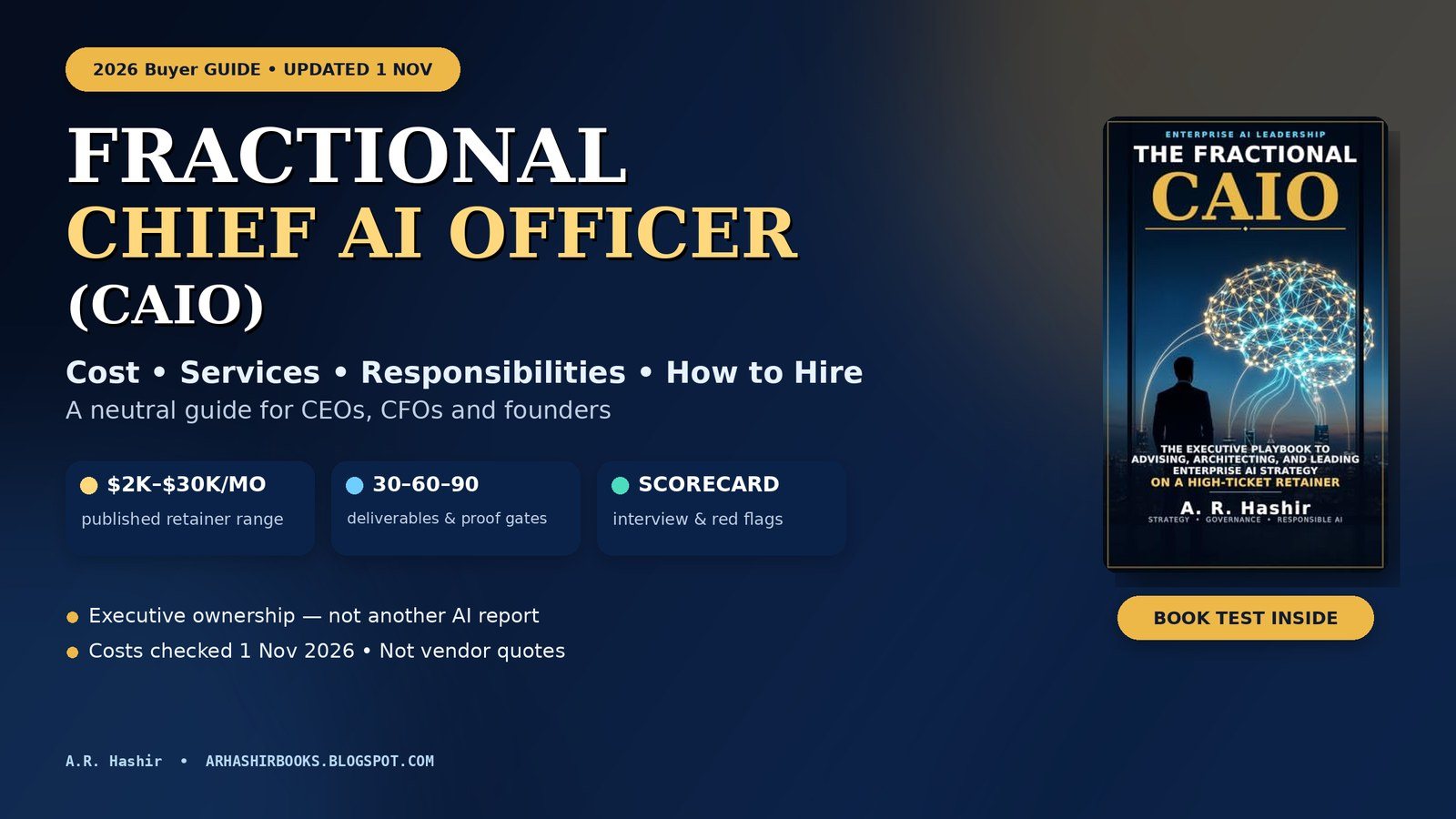
Figure: A fractional CAIO is not a part-time opinion. The useful version is a written executive mandate covering money, decisions, delivery proof and risk.
Most companies do not have an “AI tool” problem. They have an ownership problem. Departments buy subscriptions independently. Employees experiment with customer data in tools nobody reviewed. Vendors promise transformation while internal teams cannot agree on the data, workflow or success metric. The CFO sees AI spend rising; the board asks for return on investment; legal, security and privacy teams inherit risks after the purchase. A Chief AI Officer exists to connect those decisions. A fractional CAIO lets a company buy that accountability before it needs—or can recruit—a full-time C-suite hire.
This guide is written for the buyer. It explains what a fractional Chief AI Officer does, the services and responsibilities to put in writing, what the role costs in 2026, how it differs from a full-time CAIO, CTO, CDO, Head of AI, AI consultant and agency, when not to hire one, and how to evaluate candidates with a scorecard instead of charisma. A compact practitioner section and an honest test of the author’s book appear only after the buyer guide is complete.
On this page
- What is a fractional Chief AI Officer?
- Why the CAIO role is growing
- Fractional CAIO responsibilities and services
- Fractional Chief AI Officer cost in 2026
- Fractional CAIO vs full-time CAIO, CTO, consultant and Head of AI
- When to hire one—and when not to
- What changes for startups, SMBs, mid-market firms and enterprises
- The 30-60-90 day fractional CAIO plan
- Governance: NIST, ISO/IEC 42001 and the EU AI Act
- How to hire a fractional Chief AI Officer
- Interview questions, scorecard and red flags
- Sample mandate and contract clauses
- KPIs and the monthly board pack
- Mistakes that turn a fractional CAIO into expensive advice
- For operators: becoming a fractional CAIO
- The author’s book—and the 10-minute sample test
- Fractional Chief AI Officer FAQs
- Sources, method and update note
What is a fractional Chief AI Officer?
A fractional Chief AI Officer is an experienced AI leader embedded in the business for a defined number of days per month or week. “Fractional” describes the time commitment, not a fraction of accountability. Within the agreed mandate, the person is responsible for making and documenting executive-level AI decisions—not merely recommending tools and leaving the consequences to someone else.
The role normally combines five forms of ownership. First, portfolio ownership: which AI use cases deserve money, which should wait and which should stop. Second, financial ownership: business cases, total cost, benefit owners and evidence that value survived contact with operations. Third, technology ownership: model, data, architecture, vendor and build-or-buy judgment in partnership with engineering. Fourth, risk ownership: acceptable use, evaluation, human oversight, privacy, security and regulatory readiness with the accountable specialists. Fifth, adoption ownership: workflow redesign, training and reporting so a successful pilot becomes normal work.
A useful test is simple: if the person cannot say no, stop a weak vendor purchase, require an evaluation, escalate a data problem or report an uncomfortable result to the CEO, you have bought an adviser with a grand title—not a fractional Chief AI Officer.
Fractional CAIO, fractional AI officer, part-time CAIO and virtual CAIO: are they the same?
The market uses several labels for overlapping offers. Searchers also use fractional AI officer, part-time Chief AI Officer, interim Chief AI Officer, virtual CAIO and occasionally fractional Head of AI. The label matters less than four written facts: decision rights, cadence, deliverables and whether the same named person will attend the difficult meetings. An “interim” appointment often implies a temporary bridge to a permanent hire; a “virtual” offer may be remote advisory time; a “Head of AI” may manage builders rather than hold a board mandate. Buy the mandate, not the synonym.
Why the Chief AI Officer role is growing
The CAIO title is moving from novelty to an operating-model response. IBM Institute for Business Value research conducted in early 2025 surveyed more than 600 CAIOs and reached more than 2,300 organizations; 26% said they currently had a CAIO, up from 11% in 2023. IBM also reported that organizations with CAIOs saw 10% greater ROI on AI spend. Treat that number as a survey association, not proof that hiring any person with the title causes a 10% return. The useful lesson is narrower: as AI moves from isolated pilots to shared budgets, multiple models, sensitive data and customer-facing decisions, a named portfolio owner becomes harder to avoid.
The same IBM work describes CAIOs defining AI strategy, directing implementation, managing AI budgets and developing change-management plans. It also notes that a typical organization uses multiple generative AI models, increasing the need for model choice, evaluation and retirement discipline. In the United States, federal policy offers a public-sector example—not a private-company mandate: OMB Memorandum M-25-21 requires federal agencies to designate Chief AI Officers and strengthen AI governance. Private companies are not bound by that instruction, but boards increasingly ask the same practical question: Who, by name, is accountable for AI value and AI risk?
A fractional model emerges when that question is urgent but the permanent role is not yet five days a week. It can also be a disciplined discovery period: define the mandate, produce the first portfolio and learn whether the eventual full-time seat should be a strategist, an operator, a governance leader or a Head of AI who manages a build team.
Fractional Chief AI Officer responsibilities and services
Do not buy “AI leadership” as a cloud of meetings. Convert the role into services, artifacts and review dates. The table below is the service catalogue to adapt. Your company may not need every item, but anything excluded should be excluded deliberately.
What a fractional CAIO does week to week
The exact cadence depends on the tier, but a serious engagement has a rhythm. Weekly, the fractional Chief AI Officer reviews active use cases with their business and technical owners, clears decisions, inspects evaluation failures and checks spend. Every two weeks, they review vendor/model changes, data blockers and human-review quality. Monthly, they update the portfolio, risk register and cost/value dashboard for the executive sponsor. Quarterly, they recommend what to scale, pause, replace or bring in-house and whether the fractional mandate should expand, shrink or convert to a permanent role.
Attendance is not the deliverable. A calendar full of “AI syncs” can hide an empty portfolio. Judge the work by inventory completeness, decisions closed, pilots that reached controlled production, measured quality, cycle time, unit cost, risk evidence and benefits verified by the business owner—not by the number of workshops held.
What the role is not
- Not the only builder. Some fractional CAIOs can prototype, but production software still needs accountable engineering, data, security and operations owners.
- Not a prompt trainer with an executive title. Prompt skill helps; it does not replace portfolio economics, evaluation or governance.
- Not a substitute DPO, CISO, general counsel or CDO. The CAIO coordinates AI decisions; regulated duties remain with qualified accountable functions.
- Not a vendor reseller. Undisclosed commissions turn build-or-buy advice into distribution.
- Not a guarantee of ROI. A good CAIO improves the quality and speed of decisions; markets, data, adoption and execution still determine results.
How much does a fractional Chief AI Officer cost in 2026?
There is no official market rate card for a role this new. Most public prices are published by the same firms and independent operators selling the service, so treat them as list-price planning ranges, not a salary survey or quote. An October 2026 synthesis by Pareto Talent of published pages from Knight Ops, HatchWorks AI and iternal.ai found fractional Chief AI Officer rates from about $2,000 per month for light advisory work to $30,000 per month for two to three days a week; the middle—roughly one day a week—was listed around $5,000 to $15,000 per month. iternal.ai separately publishes about $4,000–$8,000 for roughly two days a month, $8,000–$15,000 for roughly one day a week and $15,000–$30,000 for two to three days a week. The consolidated planning bands below overlap because scope, seniority and sector change the price more than the label does.
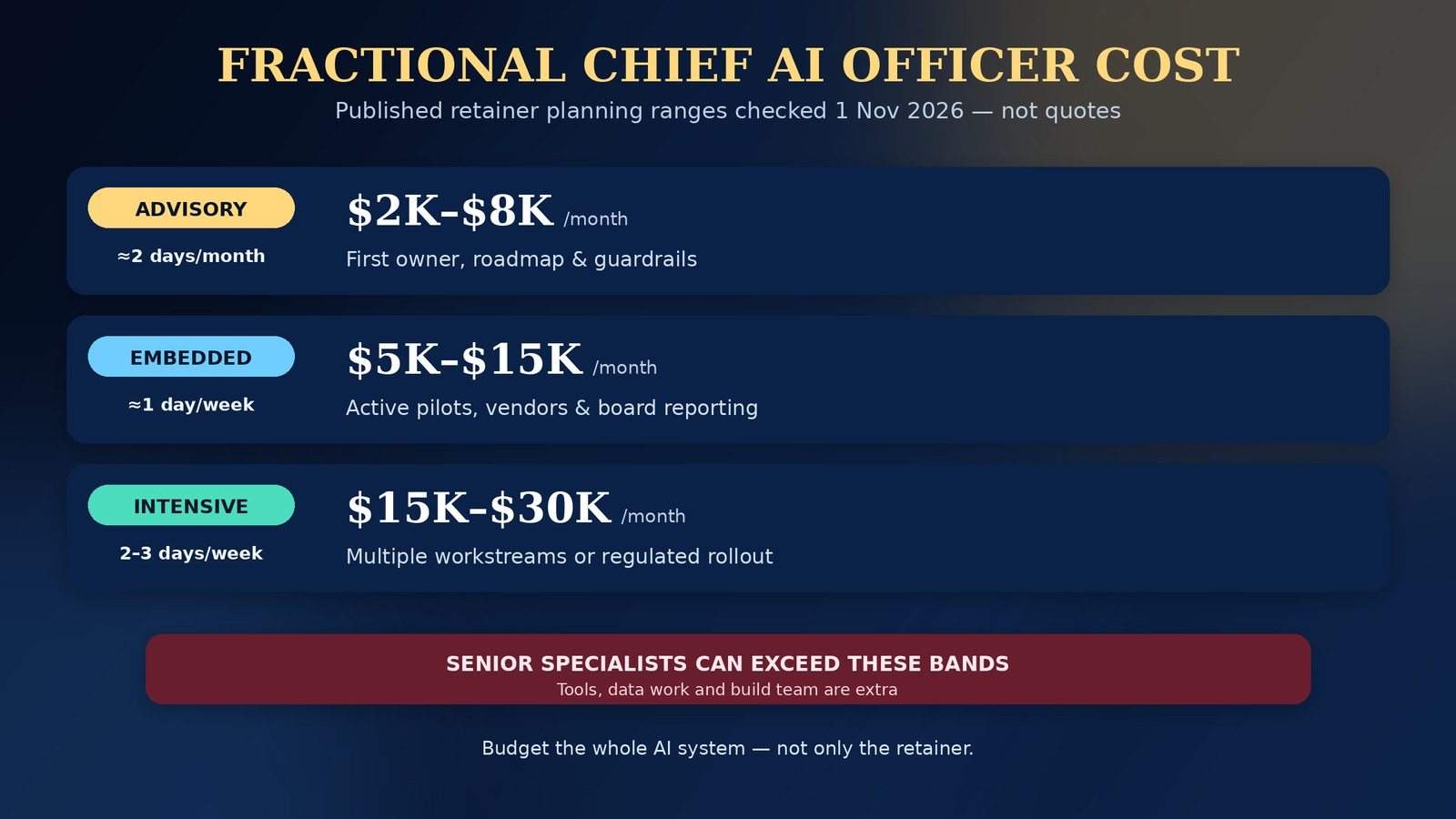
Figure: Published fractional CAIO retainers checked 1 November 2026. Use the bands to budget the conversation, then price the exact mandate.
The annual equivalent is only a multiplication, not a prediction that every engagement should run twelve months. Many buyers should start with a paid diagnostic or a 90-day mandate with a written scale/stop decision. A low retainer with no access, no builders and no decision rights is expensive. A higher retainer that prevents one bad platform commitment or moves one valuable workflow safely into production may be cheap. Compare cost against the decisions and artifacts purchased—not hours in a chair.
Pricing models you may be offered
The retainer is not the total AI cost
Budget the whole system:
This is where impressive demos become honest budgets. A “saved” hour only becomes economic value if capacity is redeployed, overtime falls, throughput rises, error/rework drops or revenue quality improves. Your fractional CAIO should record the baseline and benefit owner before the pilot starts, then report gross benefit, total cost and confidence level separately.
Full-time Chief AI Officer salary and total cost
Full-time compensation varies so widely because “Chief AI Officer” can describe a strategist, an operator, a governance owner or a frontier-technology executive. KORE1’s 2026 salary guide puts U.S. Chief AI Officer base salary broadly around $280,000–$650,000, before bonus, equity and signing payments. Its hiring guide suggests many U.S. companies should budget roughly $400,000–$800,000 in total compensation and allow three to five months for a genuine executive search; large enterprises and frontier AI companies can go far higher. Those are recruiter-market planning figures, not a universal quote. Add employer costs, search fees, onboarding time and the team the executive will need.
That comparison explains the fractional appeal—but do not use it lazily. A $120,000 annual fractional retainer buys part-time leadership, not a full-time executive plus an AI department. The honest comparison is cost per accountable decision and production outcome over the next two quarters, given the team you already have.
Fractional CAIO vs full-time CAIO, CTO, CDO, consultant and Head of AI
Title confusion is expensive because each role solves a different bottleneck. Use this comparison before writing a job description or signing a retainer.
Fractional CAIO vs AI consultant: the one-line difference
A consultant is accountable for a deliverable; a fractional CAIO is accountable for the continuing portfolio and the decisions after the deliverable arrives. If your sentence begins “We need a report/prototype by…,” buy consulting or building. If it begins “Every month we must decide what to fund, buy, govern and scale…,” you are describing an executive mandate.
Fractional CAIO vs fractional CTO: which gap is real?
Choose the CTO when architecture, engineering management, platform reliability or technical hiring is the constraint. Choose the CAIO when AI investment choice, model/vendor economics, AI risk, workflow adoption and board reporting are the constraint. Growing companies may need both, with a written boundary: the CTO owns how systems are built and run; the CAIO owns why an AI use case deserves capital, what evidence it must produce and whether it should scale. They should challenge each other in the open, not run rival AI empires.
When to hire a fractional Chief AI Officer—and when not to
Score your company honestly. The more statements that are true, the stronger the case for an embedded mandate rather than another tool purchase.
- AI spend is fragmented. Multiple teams buy models, copilots, agents or point tools without a shared inventory or renewal logic.
- Pilots multiply but production does not. Demos please executives, then stall on data access, security review, evaluation, integration or workflow ownership.
- Shadow AI is already real. Employees use unapproved tools with client, employee, financial, health, legal or proprietary data.
- Vendor claims outrun internal judgment. Nobody can compare total cost, data retention, model quality, switching cost and failure behavior on equal terms.
- The board wants numbers. Leadership cannot state AI spend, benefits, unresolved risks and next funding gates on one page.
- Data exists but decisions do not. The issue is prioritization and cross-functional authority, not finding one more model.
- A regulated or customer-facing launch is approaching. Human oversight, recordkeeping, evaluation and incident response must exist before scale.
- You may hire full-time within a year. A fractional leader can define the real role, prove the portfolio and write a sharper permanent scorecard.
- Several business units need the same answer. A central mandate prevents each unit from buying a different version of the same capability.
When a fractional CAIO is the wrong buy
- No sponsor will enforce decisions. If the CEO will not attend the monthly review or allow weak projects to stop, save the retainer.
- There is nobody to build or operate anything. Hire/contract the builder and name an internal product owner first; use the CAIO for a short diagnostic only if needed.
- The problem is one known integration. A fixed-scope engineer, agency or AI operator is usually better value.
- The real bottleneck is basic data or process chaos. A CDO, operations leader or data engineer may need to precede AI scale.
- The workload is honestly five days a week. Stretching a fractional person beyond the mandate creates delay and key-person risk.
- You want the title for fundraising or public relations. Investors and customers eventually inspect artifacts. Governance theater is easy to detect.
- The candidate will not document decisions. Executive memory is not an operating system, especially when the person leaves.
When to convert fractional to full-time
Convert when demand is proven, not when the calendar merely looks busy. Useful triggers include: several production AI systems with material customer or regulatory impact; recurring decisions that cannot wait for the fractional cadence; a growing internal AI/data/product team needing daily management; AI revenue, cost or risk large enough to require a permanent P&L-style owner; or two consecutive quarters at roughly three days a week with a forecast that remains above that level. The fractional CAIO should help write the permanent role scorecard and may be a candidate—but the conversion decision should still be evidence-based.
What a fractional CAIO should do for startups, SMBs, mid-market companies and enterprises
The 30-60-90 day fractional Chief AI Officer plan
Ninety days is long enough to replace opinions with evidence and short enough to avoid an open-ended advisory habit. The plan should begin with a named executive sponsor, access to finance, technology, data, security, legal/HR and the operators who do the target work. The fractional CAIO should not request “a few months to learn the business” before producing artifacts.
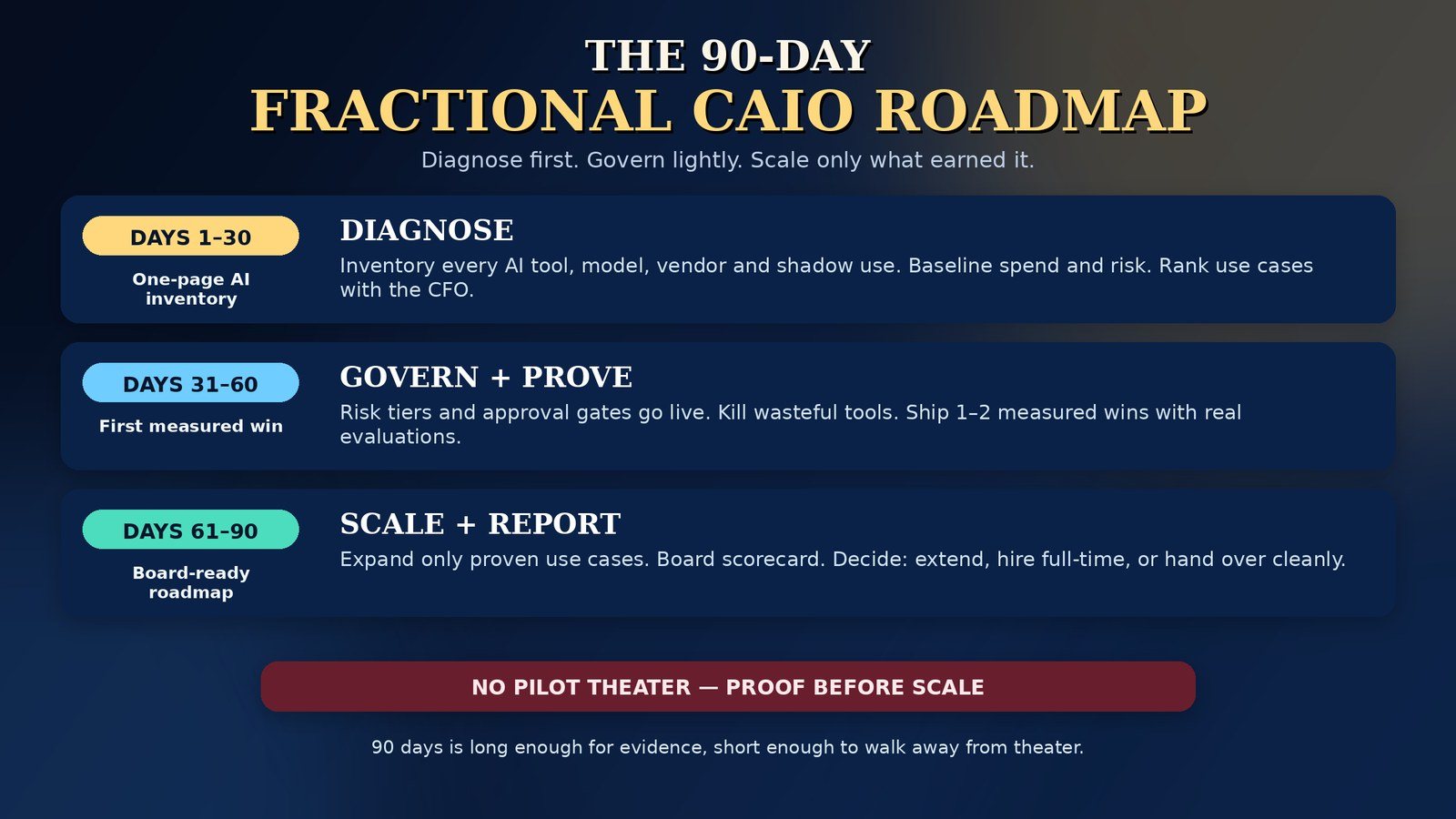
Figure: Diagnose before buying, govern before scaling and make day 90 a funding decision—not a victory presentation.
Illustrative 120-person company scenario
This is a planning scenario, not a client case study. A 120-person services company hires a fractional Chief AI Officer for about one day a week. In the first month, the inventory finds 17 AI-touching tools, four with access to client material and two overlapping subscriptions. The CAIO pauses a company-wide agent launch, agrees data rules with the operations lead and chooses two narrower tests: drafting internal status summaries from approved project records and classifying inbound support requests with a human confirmation step.
By day 60, the summary workflow has an evaluation set drawn from real projects; factual omissions are tracked instead of hidden by a polished demo. The support classifier is useful for three categories but unreliable for contract disputes, so those remain human-routed. By day 90, leadership sees duplicate subscriptions cancelled, the first workflow released to a limited team, model/API unit cost per summary, review time, escalation rate and a decision not to scale the risky category. The win is not “AI transformation.” It is a smaller, more valuable thing: evidence strong enough to fund the next step.
AI governance without bureaucracy: NIST, ISO/IEC 42001 and the EU AI Act
No major framework says, “Hire a person called CAIO.” What they require—or recommend—is named accountability, documented roles, risk management and evidence. A fractional Chief AI Officer is useful when they convert those ideas into the lightest operating system that fits the company’s actual AI risk.
The minimum viable governance spine
- Inventory: every material AI system/tool, business owner, vendor/model, data category, users, cost and renewal date.
- Risk tiers: low-risk internal drafting is not governed like credit, employment, health, safety or customer-impacting automation.
- Data rules: approved tools, prohibited data, retention/training terms, access and deletion routes stated in language employees understand.
- Human accountability: a named person can approve, override, pause and explain each material AI-assisted decision.
- Evaluation before scale: real test cases, failure examples, quality thresholds, bias/robustness checks where relevant and a rollback route.
- Vendor diligence: security, subprocessors, data use, model changes, uptime, audit logs, export/exit and incident notification.
- Monitoring and incidents: drift, cost spikes, unsafe outputs, complaints and near-misses have an owner and response path.
- Training by role: executives, reviewers, builders and everyday users need different instructions.
For AI agents that can send, buy, publish, delete or change records, approval gates deserve special attention. Our personal AI assistant and agentic AI guide explains autonomy levels and “approve before action” design in practical terms. The enterprise version is the same principle with stronger identity, logging and separation of duties.
How to hire a fractional Chief AI Officer
Step 1: Write the mandate before the job advertisement
Start with the business problem, not a shopping list of fashionable skills. State the sponsor, decisions required in 90 days, current team, data/access constraints, budget envelope and evidence of success. Decide which CAIO archetype you need most: strategist (portfolio and investment), operator (production and adoption) or governance owner (risk, controls and assurance). Exceptional candidates may cover all three, but pretending they are identical produces a vague search.
Step 2: Choose the sourcing route deliberately
There is no universally “best fractional Chief AI Officer.” The best choice is the person or firm whose proven operating context matches your first 90-day mandate and whose conflicts, cadence and artifacts can be written down.
Step 3: Screen for artifacts, not vocabulary
Ask for redacted examples of an AI inventory, portfolio ranking, vendor decision memo, evaluation scorecard, board update and a project they stopped. Confidentiality may limit detail, but the structure reveals whether the candidate has operated a system or only described one. Check whether past claims distinguish their personal decisions from a large team’s work.
Step 4: Run a paid, bounded work sample
Give finalists the same messy packet: five proposed use cases, current tools and spend, one vendor quote, data constraints and a board question. Ask for a 30-day plan, first two decisions, evaluation design, total-cost view and what they would refuse to launch. Pay for the exercise. Senior operators should not be expected to donate a consulting project, and free exercises attract sales decks.
Step 5: Reference the failure record
Ask references what the candidate stopped, where they were too slow or too optimistic, how they handled security/legal pushback and whether artifacts survived their exit. A spotless success story in enterprise AI usually means the difficult parts are missing.
Step 6: Contract a 90-day proof period
Agree cadence, named lead, decision rights, availability, artifacts, review dates, conflicts, documentation ownership and exit/handover before the first workshop. Put the extension/full-time conversion decision on the calendar now.
Fractional CAIO interview questions and hiring scorecard
A 100-point scorecard
Score evidence, not confidence. Any zero for undisclosed conflicts, refusal to document decisions or inability to explain total cost should override an otherwise impressive total.
Sample fractional CAIO mandate you can copy
Replace the brackets, keep it to one or two pages and have qualified counsel review the actual contract. A mandate is an operating agreement, not a motivational poster.
FRACTIONAL CHIEF AI OFFICER — 90-DAY MANDATE

Company/sponsor: [Company] / [CEO or named executive]
Fractional CAIO: [Named person — no unapproved substitution]
Cadence: [e.g., 1 day/week; executive session every Tuesday]
Term and review: [Start date] to [Day 90]; scale/stop decision on [date]

Purpose
Create one accountable system for AI investment, delivery, risk and reporting.

In scope
- AI inventory, spend baseline and ranked use-case portfolio
- Build-or-buy and vendor recommendations within [approval limit]
- Minimum governance, evaluation and human-oversight standards
- Pilot oversight for [named workstreams]
- Monthly board/executive pack and decision log

Decision rights
CAIO may approve: [low-risk pilots/tools up to $X]
Sponsor must approve: [customer-facing launch, sensitive data, spend above $X]
CAIO must escalate: [legal/security/privacy/safety exception]

Out of scope
- Sole production engineering or 24/7 operations
- Final legal, privacy, tax or regulatory sign-off
- Vendor selection where an undisclosed conflict exists

Day-30 deliverables
[Inventory] [Portfolio] [Urgent risks] [Decision queue]
Day-60 deliverables
[Guardrails live] [Pilot evaluations] [Vendor decisions]
Day-90 deliverables
[Board pack] [Scale/stop recommendations] [Six-month roadmap]

Measures
[Benefit] [Quality] [Adoption] [Unit cost] [Risk/incidents]

Conflicts and independence
All vendor compensation/relationships disclosed in writing.

Documentation and exit
Company owns mandate artifacts/decision records. Final handover includes
inventory, evaluations, SOPs, open risks and named internal owners.
Contract clauses buyers often forget
- Named individual and approval required for substitution or subcontracting.
- Availability, response windows and what counts as a fractional “day.”
- Decision authority and spending limits; meeting attendance is not authority.
- Confidentiality, data access, security controls, return/deletion and approved AI tools for the CAIO’s own work.
- Vendor commissions, equity, referral fees and competing-client conflicts.
- Ownership/licence of templates, decision logs, evaluations, prompts/configuration and documentation.
- Termination, final artifacts, knowledge transfer and reasonable post-exit availability.
- Conversion/recruitment fees if the fractional leader or introduced candidate becomes an employee.
KPIs and the monthly board pack
A board does not need a model leaderboard. It needs to know what changed, what it cost, what could hurt the company and what decision is requested. Track a small set of measures across five categories.
A practical monthly pack fits on a few pages: portfolio status; spend and verified value; production quality; top risks and incidents; decisions required; stop/scale recommendations; and changes to the full-time hiring trigger. If an agent workflow is involved, include autonomy level, approval rate and override reasons. If your public brand is also being summarized by AI systems, track that separately with an AI visibility audit; do not confuse external discoverability with internal AI operating performance.
Mistakes that turn a fractional CAIO into expensive advice
- Hiring the title before the mandate. The result is a senior meeting attendee with no authority.
- Funding tools before baselines. Without current cost, quality and cycle time, every later ROI claim is theater.
- Confusing a demo with evaluation. Production needs edge cases, permissions, monitoring and rollback.
- Hiding the build gap. Strategy cannot compensate for zero engineering, data or product ownership.
- Letting vendors grade themselves. The buyer needs raw evaluation outputs and exit terms.
- Governance as a PDF. Policy matters only when inventory, gates, records and training change behavior.
- No stop rule. Every pilot needs a date and evidence threshold for scale, redesign or termination.
- Counting saved minutes that nobody uses. Finance should verify how capacity became output, lower cost or better quality.
- Keeping knowledge in the fractional leader’s head. Documentation is a deliverable from week one.
- Refusing to convert or exit. A good fractional mandate either proves a permanent need or makes itself unnecessary.
For operators: how to become a fractional CAIO without becoming a hype merchant
This buyer guide has a second, smaller audience: experienced consultants, architects, data/AI leaders and operators who want to sell fractional Chief AI Officer engagements. The ethical route is not to print a new title on a profile. It is to package accountable work that passes the same scorecard above.
- Lead with a diagnostic. Offer a fixed-scope inventory, spend/risk baseline, ranked portfolio and 90-day plan. The client receives evidence; you learn whether a retainer is justified.
- Publish clear tiers. Advisory, embedded and intensive should state cadence, artifacts, response windows, exclusions and review dates.
- Show an operating trail. Redacted inventories, decision memos, evaluations, board packs and stopped projects persuade better than model-name bingo.
- Refuse hidden vendor economics. If a platform pays you, disclose it. Independence is a core part of the product.
- Make governance usable. Many people can demo an agent; fewer can leave behind an inventory, approval trail, evaluation set and trained owner.
- Promise process, not income or transformation. You can promise dates, artifacts and decision quality. Client outcomes still depend on their team, data and market.
That practitioner lane is the bridge to the book below. It is deliberately placed after the employer guide: a credible fractional CAIO offer should be built from the buyer’s risks outward, not from the seller’s desired retainer inward.
The Fractional CAIO book: an honest fit test
Disclosure: THE FRACTIONAL CAIO: The Executive Playbook to Advising, Architecting, and Leading Enterprise AI Strategy on a High-Ticket Retainer is my book. This section is therefore written as a buyer’s checklist, not an independent review.
Amazon facts checked on 1 November 2026: the Kindle edition is $9.99 or available through Kindle Unlimited, the paperback is $11.99, and a free Kindle sample is available. Amazon currently displays 1.0 out of 5 stars from exactly one rating. I am not going to hide that or speculate about the rater. One rating is a real data point; it is not enough information to judge an entire book. Amazon also displays different format measures—a 409-page Kindle print-length estimate and a 138-page paperback listing—so use the table of contents and sample, not page-count marketing.
The book’s own description says it includes a 30-day daily action tracker, a 100-term enterprise AI glossary, diagnostic frameworks and scripts, contract materials, zero-data-retention vendor-vetting matrices and retainer economics. Treat those as claims to verify in the free sample. The strongest reason to consider it is fit: it is aimed primarily at consultants, architects and operators who want to package and deliver fractional CAIO work, and secondarily at executives who want to understand what a serious offer and mandate should contain. It is not a coding tutorial, a prompt collection or a promise of clients or income.
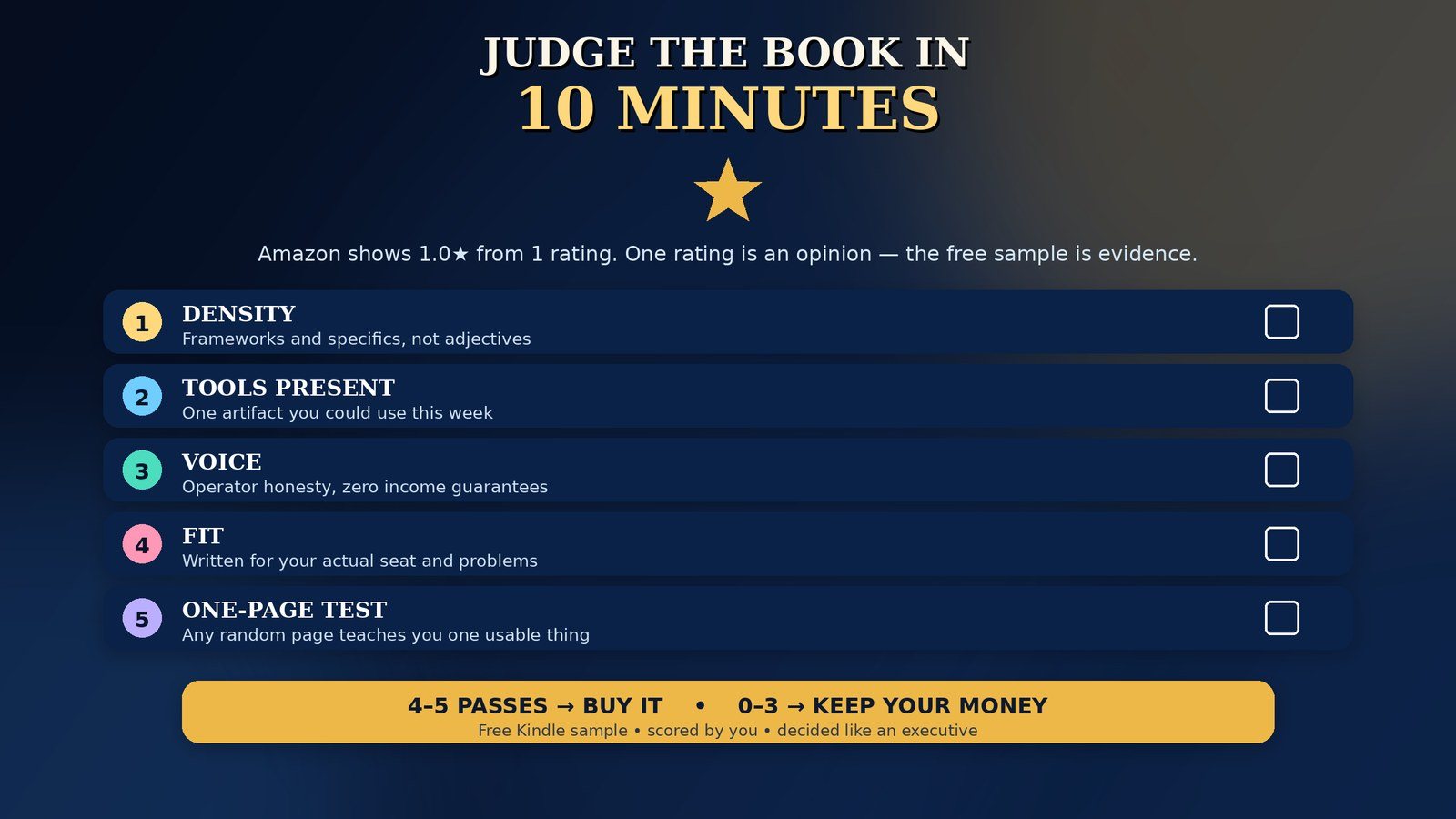
Figure: Do not trust the single star and do not trust the author. Run the free sample against five checks and let the pages vote.
Decision rule: four or five passes means the book has earned a purchase or Kindle Unlimited slot for your seat. Zero to three means close the sample and keep your money. Either result is a fair outcome. If you genuinely read it, an honest review—positive or critical—will help the next reader more than a lone unexplained star.
Run the free sample test before spending anything.
📘 Get the Free Sample / Read on Kindle — $9.99 or KU
Prefer print? Paperback — $11.99 • More books by A.R. Hashir
Fractional Chief AI Officer FAQs
What is a fractional Chief AI Officer?
A fractional Chief AI Officer, or fractional CAIO, is a part-time senior AI executive on a recurring cadence who owns AI strategy, portfolio priorities, build-or-buy/vendor decisions, governance, delivery oversight, adoption and executive reporting within a written mandate.
What does a fractional CAIO do?
They inventory AI use and spend, rank use cases with business owners, set data/model/vendor guardrails, require evaluations before scale, oversee pilots into production, track total cost and value, and report decisions and risks to leadership.
How much does a fractional Chief AI Officer cost?
Published planning examples checked on 1 November 2026 range from about $2,000–$8,000 per month for light advisory time, $5,000–$15,000 for roughly one day a week and $15,000–$30,000 for two to three days a week. Senior specialists can charge more. Tools, model usage, data work and builders are extra.
How many days a week does a fractional CAIO work?
Common models range from about two days per month to three days per week. If decision volume, production risk and team management honestly require five days, hire a full-time CAIO or Head of AI.
Fractional CAIO vs AI consultant: what is the difference?
A consultant is accountable for a defined deliverable. A fractional CAIO is accountable for the continuing AI portfolio, recurring decisions, governance and whether funded work reaches safe, measured production.
Fractional CAIO vs fractional CTO: which do I need?
Choose a CTO for engineering/platform leadership. Choose a CAIO for AI investment priorities, model/vendor economics, AI-specific evaluation and governance, adoption and board reporting. Larger or AI-heavy companies may need both with clear boundaries.
When should a startup or small business hire a fractional CAIO?
Only when AI decisions already affect material cost, customer trust, sensitive data or product direction and an internal owner/builder exists. Very small companies often need a short diagnostic, a builder and simple approval rules before an executive retainer.
Can a fractional CAIO work in healthcare, finance or other regulated industries?
Yes, if the person has relevant operating evidence and works with accountable legal, compliance, privacy, security and domain leaders. Require an evidence trail for data use, evaluation, human oversight, vendor diligence, monitoring and incidents; the CAIO title alone is not compliance.
Does a fractional Chief AI Officer build the AI systems?
Usually they direct and accept the work rather than serve as the sole engineer. Some can prototype, but production still needs accountable engineering/data/operations owners and clear acceptance tests.
What should the first 30 days produce?
A complete AI inventory with owners, cost and risk; a ranked use-case portfolio with baselines; urgent data/vendor issues; and a short decision queue for the executive sponsor. A vision deck without those artifacts is not enough.
How do you measure fractional CAIO performance?
Measure decisions closed, pilots reaching controlled production, task quality, adoption, unit cost, verified business benefit, risk evidence and duplicate spend removed. Require the business owner—not only the CAIO—to confirm benefits.
Is a CAIO certification required?
No universal licence or certification defines a Chief AI Officer. Training can help, but buyers should weight production artifacts, references, economics, governance evidence and a paid work sample far more heavily than a course badge.
Can one fractional CAIO serve several companies?
Yes—that is the model—but capacity, confidentiality, competing-client conflicts, response times and information barriers must be explicit. Ask how many active mandates the named person carries.
How fast can a fractional CAIO start?
Often faster than an executive search, sometimes within weeks, but start speed depends on access, contracting and the named person’s capacity. Do not skip mandate, conflict and reference checks to save a few days.
Should I trust a fractional CAIO book with a 1-star rating?
Trust neither one unexplained rating nor the author’s sales copy. Download the free sample, run the five checks above and decide from the pages. If the sample does not fit your seat, do not buy it.
Sources, method and update note
This guide was updated on 1 November 2026 after reviewing current fractional-CAIO provider/editorial pages and separating three kinds of evidence: peer research, recruiter compensation guides and prices published by firms selling fractional services. Cost figures are planning ranges, not quotes, salary guarantees or procurement advice.
- IBM Institute for Business Value — How Chief AI Officers deliver AI ROI: CAIO adoption, responsibilities and survey-reported ROI association.
- KORE1 — Chief AI Officer Salary Guide 2026 and How to Hire a Chief AI Officer: recruiter-market base/total compensation and search planning ranges.
- Pareto Talent — Fractional Chief AI Officer: Cost, Role and Alternatives: dated synthesis of published provider retainers and the important warning that sellers publish many of the available prices.
- iternal.ai — Fractional Chief AI Officer cost tiers: example cadence-based published ranges.
- Uvik — Best Fractional Chief AI Officer (2026): premium independent-operator positioning and scenario patterns; treat its top-end market figures as one provider-side guide, not a benchmark survey.
- NIST AI Risk Management Framework — Core and Profiles: Govern accountability, roles and executive responsibility.
- ISO/IEC 42001: AI management-system scope and leadership context.
- European Commission — EU AI Act framework: risk-based regulatory context; obligations depend on role, system and timing.
- OMB Memorandum M-25-21: U.S. federal-agency CAIO example, not a private-sector requirement.
- Book price, format, sample and rating facts were checked on the Amazon product pages linked above on 1 November 2026 and may change.
Your next step: before interviewing anyone, create a one-page inventory of every AI tool, model, agent and vendor already touching company work—with owner, data category, monthly cost and renewal date. If that page cannot be assembled within a week, you have found the first deliverable your fractional Chief AI Officer must own.
Save or share this guide: Fractional Chief AI Officer (CAIO) cost, services, responsibilities and hiring guide.
Comments
Post a Comment
Thanks for joining the discussion. Please keep comments helpful and relevant. Comments are moderated, and promotional spam links will be removed.