By A.R. Hashir • Last updated: 4 November 2026 • Exam-ready answer with examples, traps and practice questions
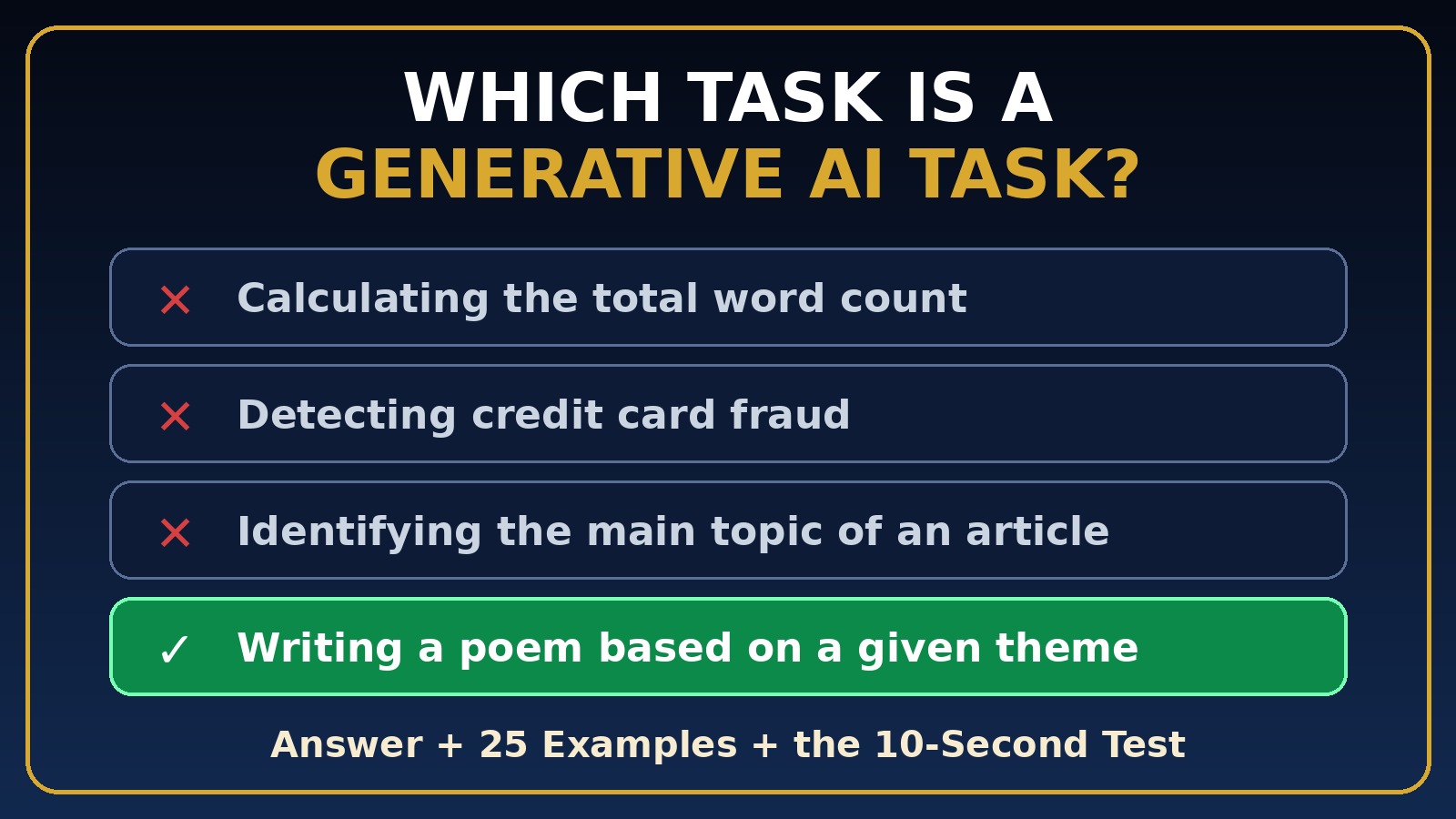
Question: Which task is a Generative AI task?
- Calculating the total word count in an article ❌
- Detecting credit card fraud ❌
- Identifying the main topic of a news article ❌
- Writing a poem based on a given theme ✅
Correct answer: Writing a poem based on a given theme. It is the only option where the AI must create new content — a poem that did not exist before. Counting words is simple calculation, detecting fraud is classification, and identifying a topic is labeling existing text. None of those three creates anything new.
Note: the option letter (A/B/C/D) changes from paper to paper. Remember the task, not the letter.
This one question appears in school AI subjects, certification quizzes and interview screenings all over the world — and it catches people because all four options sound like “things AI does.” They are not the same kind of thing. Below you will get the 10-second test that answers every version of this question, option-by-option reasoning, 25 generative examples, 15 non-generative examples, the borderline traps examiners love, and 15 practice MCQs with an answer key.
On this page
- The 10-second test
- Why the other three options are wrong
- What “generative” actually means
- Generative vs discriminative vs predictive vs analytical
- 25 examples of generative AI tasks
- 15 tasks that are NOT generative AI
- Borderline cases exams love to ask
- How this question appears in exams
- Practice: 15 MCQs with answer key
- One-minute revision card
- From exam answer to real AI
- Frequently asked questions
- Sources and note
The 10-second test
Ask one question about the task:
“Does the AI have to create something new that did not exist before — new text, image, sound, video or code?”
Yes → generative AI task. No → not generative. If the output is only a label (spam/not spam), a number (word count, price forecast), a decision (fraud: yes/no) or existing information found again (search result), it is not generative.
Two backup checks settle almost every tricky option:
- The verb check. Generative options usually say write, generate, create, compose, draft, produce, design. Non-generative options say detect, classify, identify, predict, calculate, count, recognize, filter, rank.
- The output check. Imagine the final screen. If it shows a fresh paragraph, picture, song, clip or program, it is generative. If it shows a tick-box, a score, a category or a sorted list, it is not.
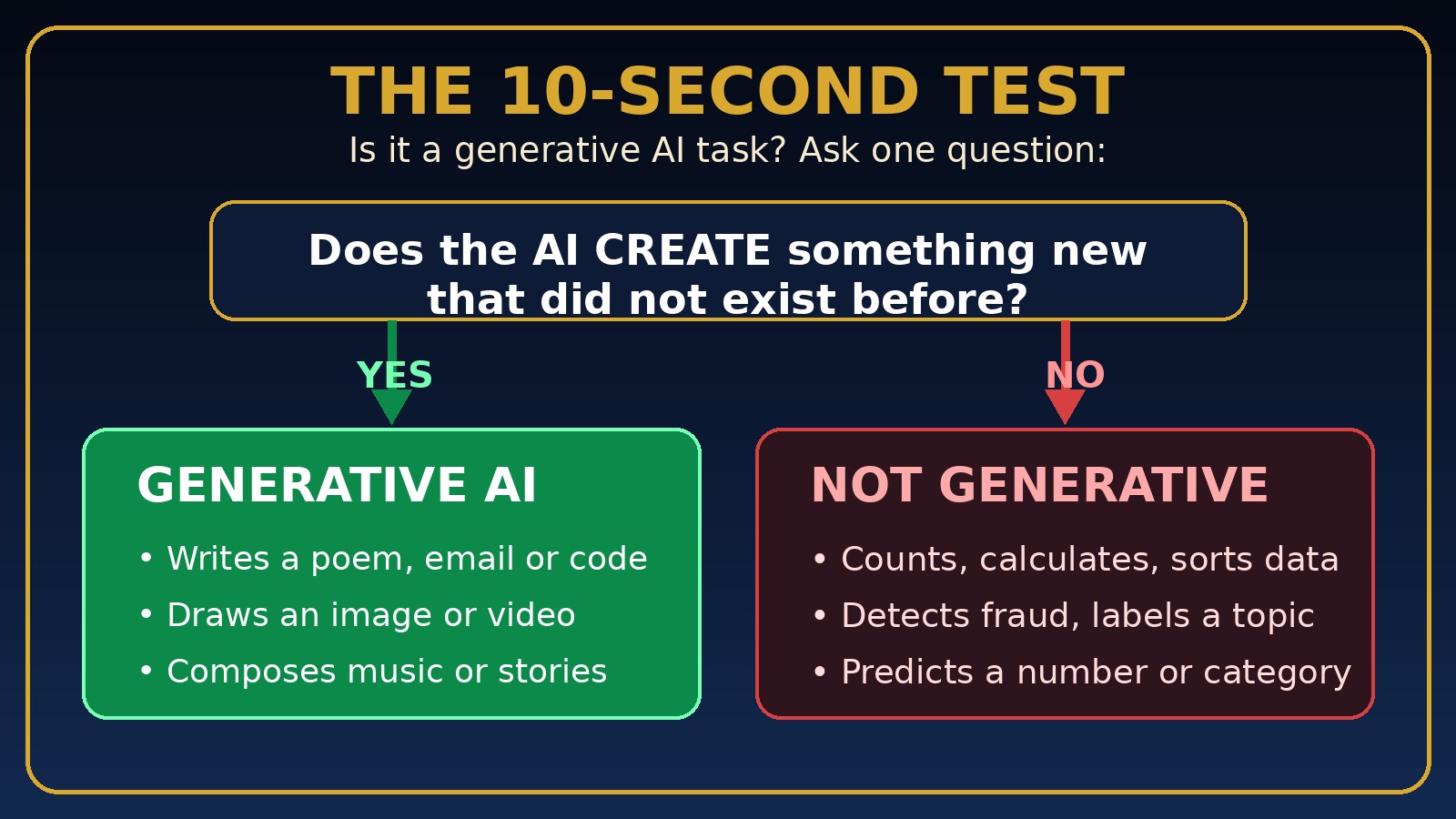
Figure: one question separates generative tasks from everything else — is new content being created?
Why the other three options are wrong
Word count fails at an even more basic level: it does not need AI at all. A fixed rule — split the text at spaces and count — solves it perfectly every time. Exam setters include it to see whether you confuse “computer task” with “generative AI task.”
Fraud detection is real, valuable machine learning, but its job is to decide: does this transaction look like the fraud pattern or the normal pattern? Deciding between known categories is the definition of a discriminative, classification-style task.
Topic identification is also a labeling job. Whether a human or a model reads the article, the answer is a category that was already true. Nothing new is written, drawn or composed.
What “generative” actually means
A generative AI system learns the patterns and structure of examples — sentences, images, sounds, code — well enough to produce new examples of the same kind. Give it a prompt or a starting point, and it generates fresh output: an essay that was never written, a face that never existed, a melody nobody composed, a function nobody typed.
Three ideas inside that definition matter for exams:
- New, not retrieved. The output is not copied from a database or chosen from a fixed list. It is produced on the spot, so two runs can give different valid results.
- Content, not a verdict. The deliverable is an artifact — text, image, audio, video, code or synthetic data — not a yes/no, a category or a single number.
- Pattern-based. The system can do this because it learned statistical patterns from training data. A word counter follows one fixed instruction; a poem writer has absorbed how poems tend to go.
Keep one subtle point separate, because advanced papers test it: the question asks about the task, not the model. The same large language model can write a poem (a generative task) and also label a review “positive” or “negative” (a classification task). In exam language, you classify by what the task produces, not by which brand of model performed it.
For completeness, here are the model families behind most generative tasks, in plain words. Large language models (LLMs) generate text and code one piece at a time, predicting what should come next — the engines behind poem writing, drafting and chatbots. Diffusion models start from visual noise and gradually refine it into a picture or video that matches a prompt. GANs (generative adversarial networks) train two networks against each other — one creates, one criticizes — and became famous for realistic faces. VAEs and related latent models compress examples into a compact pattern-space and then sample new variations from it. You do not need the mathematics for the MCQ; you only need the shared trait — every one of them exists to produce new examples, which is exactly what the word “generative” is pointing at.
Generative vs discriminative vs predictive vs analytical
Most AI multiple-choice questions are built from these four families. Learn the output of each and the variants become easy.
Two families often ride along as distractors. Recommendation systems rank existing items (the next video, a product you may like) — the output is a ranked list of things that already exist, so not generative. Retrieval/search finds existing documents; again, found is not created. Modern products blend families — a search engine may retrieve pages and then generate a summary paragraph — but in a one-line MCQ, judge the single task named in the option.
25 examples of generative AI tasks
Every task below passes the test: the AI produces content that did not exist before. Scanning the “what gets created” column is the fastest way to build exam instinct.
15 tasks that are NOT generative AI
These are the standard wrong options. Notice that several use serious machine learning — “real AI” is not the test; new content is the test.
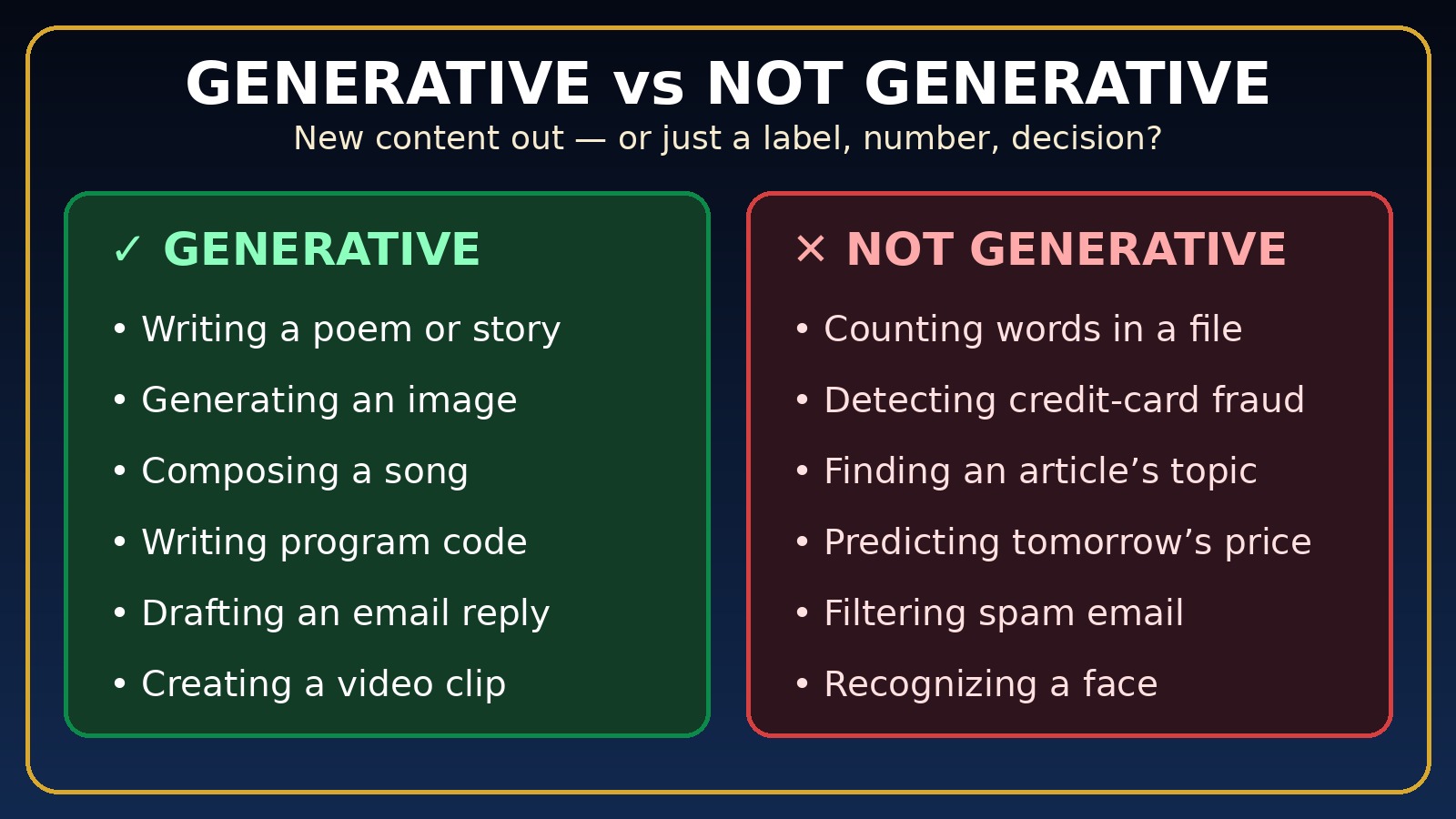
Figure: generative tasks end with new content; non-generative tasks end with a label, number, decision or found item.
Borderline cases exams love to ask
These seven cause most of the arguments in comment sections and classrooms. Each verdict below follows the rule used in this guide: judge what the task produces.
Is summarization a generative AI task?
Usually yes — when the system writes a new, shorter version in its own words (abstractive summarization), fresh text is produced, so it is generative. The exception is extractive summarization, which only copies existing sentences from the original; that is selection, not creation. Exam verdict: generative, unless the option says it merely extracts sentences.
Is translation a generative AI task?
Modern machine translation generates new sentences in the target language, so by the output test it is generative. Some basic courses file it under “transformation,” because the meaning already exists. If an MCQ forces one choice and the alternative options are counting, detecting or predicting, translation is far closer to generative than any of those. Exam verdict: generative output; treat as generative unless the question contrasts it with pure creation like poem writing.
Is a chatbot a generative AI task?
It depends on how the reply is produced. A chatbot that composes a fresh answer each time (the ChatGPT style) is performing a generative task. An old menu bot that only picks stored replies — “Press 1 for billing” — is retrieval and rules. Exam verdict: generative when it composes new replies.
Text-to-speech vs speech-to-text
They point in opposite directions. Text-to-speech synthesizes new audio that never existed — generative. Speech-to-text recognizes and transcribes what was already said — conversion/recognition, not generative. Examiners pair these two precisely because the names look symmetrical. Exam verdict: TTS generative; STT not.
Image captioning and photo repair
Describing a photo in a newly written sentence produces new text, so captioning has a generative output even though its input side is recognition. Repairing, upscaling or extending a photo invents pixels that were never captured — clearly generative (inpainting). Merely detecting what is in the photo is not. Exam verdict: captioning/repair generative; detection not.
Autocomplete and recommendations
Autocomplete that writes the next words of your sentence is generating text — generative. A recommender that ranks existing videos or products creates nothing; it orders a shelf. If the same app also generates a fresh thumbnail or headline, that part is the generative task. Exam verdict: autocomplete generative; recommendation not.
How this question appears in exams
The wording rotates, but the underlying test never changes. Watch for these forms:
- “Which task is a Generative AI task?” — the classic four options solved at the top of this page.
- “Which of the following is an example of generative AI?” — same test; pick the option that creates content.
- “What would be an appropriate task for using generative AI?” — pick the creative-production option (writing, designing, composing), not the measurement or monitoring option.
- “Which task is NOT a generative AI task?” — the trap flips: three options create content and you must find the label/number/decision hiding among them. Read the NOT twice.
- “Which task uses discriminative (or predictive) AI?” — now the correct answer is the fraud/spam/forecast style option, and the poem becomes the distractor.
One habit protects you in all five forms: before reading the options, say the test to yourself — “New content: yes or no?” Then scan the verbs. Write, generate, compose, create, draft point one way; detect, identify, calculate, predict, classify point the other. The correct option usually reveals itself in under ten seconds — hence the name of the test.
Practice: 15 MCQs with answer key
Cover the key, answer aloud, then check. Every question is original and built from the same four families. Time yourself: with the verb check and the output check working together, each question should take about ten seconds — the same pace you will have in a real test hall.
- Which task is a generative AI task?
A. Sorting emails by date B. Writing a birthday song C. Counting rows in a spreadsheet D. Flagging a duplicate invoice - Which task is NOT a generative AI task?
A. Drafting a cover letter B. Generating logo options C. Predicting which customers may cancel D. Composing background music - Which task is a generative AI task?
A. Scanning a barcode B. Counting items in a warehouse photo C. Turning a text prompt into a poster image D. Verifying a login password - A model labels each product review “positive” or “negative.” This is:
A. Generative AI B. Classification C. Text-to-speech D. Image generation - Which task is a generative AI task?
A. Producing three headline options for an article B. Ranking search results C. Compressing a file D. Measuring page load time - Which task is NOT a generative AI task?
A. Writing an ending for a story B. Creating a cartoon avatar C. Estimating tomorrow’s temperature D. Composing a ringtone - Which task is a generative AI task?
A. Recognizing a face at a door B. Producing synthetic training photos C. Totaling an invoice D. Marking an email as spam - Which task is a generative AI task?
A. Transcribing a lecture recording into text B. Narrating an article in a newly generated voice C. Identifying who is speaking D. Measuring speaking speed - Which task is a generative AI task?
A. Counting lines of code B. Sorting files by size C. Locating a syntax error D. Writing a function from a description - A tool reads a 20-page report and writes a fresh five-line summary in its own words. This is:
A. Generative (abstractive summarization) B. Word counting C. Retrieval only D. Classification - Which task is NOT a generative AI task?
A. Generating thumbnail art B. Recommending the next video C. Writing a video script D. Composing intro music - Which task is a generative AI task?
A. Detecting objects in a photo B. Reading the text inside a photo C. Filling in the torn corner of a photo D. Measuring a photo’s dimensions - Calculating the total word count in an article is best described as:
A. Generative AI B. Discriminative AI C. Deterministic computation D. Prediction - Which task is a generative AI task?
A. Routing a support ticket to a department B. Stamping the ticket’s arrival time C. Composing a new reply to the customer D. Counting today’s tickets - Which task is a Generative AI task?
A. Detecting credit card fraud B. Identifying the main topic of a news article C. Calculating the total word count in an article D. Writing a poem based on a given theme
Answer key
One-minute revision card
- Generative AI task = the AI creates new content (text, image, audio, video, code, synthetic data).
- Not generative = a label, a number, a decision, a ranking, or something found again.
- Cue verbs — generative: write • generate • create • compose • draft.
- Cue verbs — not: detect • classify • identify • predict • calculate • count.
- The classic answer: writing a poem based on a given theme ✅ — word count ❌, fraud detection ❌, main topic ❌.
- Traps: abstractive summary = generative; translation = generative output; text-to-speech = generative, speech-to-text = not.
From exam answer to real AI
Knowing which task is a generative AI task is the first rung of a ladder. The same models that write the poem now sit inside assistants that draft your email, summarize your meetings and — given tools and permission — carry small jobs across several apps by themselves. That next step has its own vocabulary: AI agents and agentic AI. If you want the buyer-level map of that world, start with our guide to personal AI assistants and AI agents, which explains what an AI agent is, how much autonomy to give one, and how to test 15 leading options safely.
Author’s book (disclosed): if you are studying AI because you want to use it — not just pass the quiz — my book NEVER HIRE AGAIN: The Complete Playbook for Building a One-Person Business with AI Agents shows how generative models become practical digital workers, with guardrails. 📘 View NEVER HIRE AGAIN on Amazon — or browse all titles on our Books on Amazon page.
Frequently asked questions
Which task is a generative AI task?
Writing a poem based on a given theme. It is the only classic option in which the AI creates new content. Calculating a word count is computation, detecting credit card fraud is classification, and identifying the main topic of a news article is labeling.
Is ChatGPT generative AI?
Yes. ChatGPT is built on large language models that generate new text (and, in current versions, other media). When you use it only to label or score something, that particular task is classification-style — but the system itself is generative AI.
Is summarizing a generative AI task?
When the summary is written in new words (abstractive), yes. When a tool only copies existing sentences from the source (extractive), it is selection rather than generation.
Is Google Translate generative AI?
Modern translation systems generate new target-language sentences rather than looking words up in a fixed table, so their output is generative. Some introductory courses still group translation under “transformation”; in mixed option sets it belongs on the generative side.
Is speech-to-text generative AI?
No. Speech-to-text recognizes and transcribes existing speech — a conversion task. The reverse direction, text-to-speech, synthesizes brand-new audio and is generative.
What is the difference between generative and discriminative AI?
Generative AI produces new examples — text, images, audio, code. Discriminative AI draws boundaries between known categories and outputs a label or decision, such as spam/not spam or fraud/not fraud.
Can one AI system do both generative and non-generative tasks?
Yes, constantly. A single assistant may classify your email, predict your busiest hour and then draft a reply. Exams classify the task being named, by what it produces — not the whole product.
Why is detecting credit card fraud not generative AI?
Because its output is a judgment about existing data — fraudulent or legitimate, often with a risk score. Nothing new is written, drawn or composed, so it is a classification/anomaly-detection task.
Sources and note
The definitions used here follow the standard industry framing of generative AI as systems that create new text, images, audio, video and code from learned patterns — see, for example, the AWS generative AI explainer. The four-option question at the top is the widely circulated exam/quiz form of this concept; option order and letters vary by paper, so this guide teaches the task-level rule instead of a letter. Practice questions above are original to this page.
Save or share this guide: Which task is a generative AI task? Answer, examples and the 10-second test.
Comments
Post a Comment
Thanks for joining the discussion. Please keep comments helpful and relevant. Comments are moderated, and promotional spam links will be removed.