By A.R. Hashir • Educational guide—not a lie-detection method, diagnosis or substitute for professional or safety advice
Short answer: To read body language accurately, do not memorize a gesture dictionary. First learn what is normal for that person—their baseline. Then look for a cluster of changes, weigh the context, check whether face, voice, words and actions agree, and confirm with a question. A cue can tell you where to look. It cannot tell you what someone secretly thinks.
Most body-language advice fails at the first step. It treats people like traffic lights: crossed arms means defensive, broken eye contact means lying, leaning in means attraction. Real people are not that simple. Crossed arms can be comfort, cold, habit, concentration or a sore shoulder. Looking away can be thought, respect, sensory overload, fatigue or a notification across the room. Leaning in can mean interest—or simply that the room is noisy.
The useful skill is quieter and much more powerful: notice what changes, when it changes, what else changes with it, and what ordinary explanation could produce the same behavior. That discipline helps you ask better questions in interviews, meetings, negotiations, friendships and relationships without turning every pause into an accusation.
This guide gives you a practical baseline method, decodes 25 common signs responsibly, separates manipulation patterns from ordinary awkwardness, and shows what to say when your read needs checking. It will not teach you to “read minds” or catch every lie. Anyone promising that is selling theatre, not accuracy.
On this page
The 60-second body-language check
When something in a conversation feels “off,” slow down and run these five checks before you interpret it:
| Step | Check | What to notice | Ask yourself |
|---|
| 1 | Baseline | How does this person normally use their face, gaze, voice, hands, posture and pace? | Is this a change—or just their normal style? |
| 2 | Cluster | Did several channels change together after a topic, person or request appeared? | Am I reacting to one gesture or to a wider shift? |
| 3 | Context | Room temperature, seating, noise, role, stakes, culture, pain, fatigue, medication, disability and time pressure. | What boring explanation fits just as well? |
| 4 | Congruence | Do the words, tone, expression, body movement and later actions broadly agree? | Which channel changed—and which stayed the same? |
| 5 | Confirm | Describe one neutral observation and ask one open question. | Can I check this respectfully instead of guessing? |
Example: A colleague folds their arms during your budget update. That alone proves nothing. If the room is cold and they keep asking engaged questions, keep going. If they were open and talkative before, then fold their arms, turn away, tighten their jaw and switch to one-word answers exactly when the deadline appears, you have a change worth exploring: “I may be moving too fast on the deadline. What part concerns you most?”
The one-sentence method: Read the change, not the pose; read the pattern, not the person; and let a question do the work that guesswork cannot.
What body language is—and what it is not
Body language is the visible and audible nonverbal part of communication: facial movements, gaze, gestures, posture, movement, distance, touch and features of the voice such as pace, pitch, volume and pauses. Timing and repeated actions also communicate, although they are behavior patterns rather than gestures.
These signals can add useful information about attention, comfort, effort, emotion, intention or social alignment. They rarely carry one fixed meaning. The same movement can be deliberate, habitual, cultural, physical or accidental. A careful reader therefore separates three things:
- Observation: “Her answers became shorter and she stopped gesturing.”
- Hypothesis: “She may be tired, confused, under time pressure or unhappy with the proposal.”
- Check: “Would it help if I paused, or is there a part you want to challenge?”
| Channel | Examples | What it may help you notice | What it cannot prove alone |
|---|
| Face | Brow, jaw, mouth, smile changes | Effort, tension, surprise, social masking or a change in affect | A precise hidden emotion |
| Eyes and gaze | Looking toward/away, blink changes, visual checking | Attention, processing, searching, discomfort or turn-taking | Honesty, attraction or guilt |
| Voice | Pace, pitch, volume, pauses, answer length | Arousal, uncertainty, emphasis, fatigue or formality | Truthfulness or competence |
| Hands and gestures | Illustrating, self-touch, stillness, object handling | Energy, emphasis, self-regulation or a change in engagement | Deception or bad intent |
| Posture and orientation | Leaning, turning, opening/closing the torso, head and foot direction | Comfort, readiness, attention, dominance displays or withdrawal | Consent, agreement or character |
| Space and touch | Distance changes, approach, retreat, handshake, pat, avoidance | Intimacy norms, status, comfort, boundaries or urgency | Romantic interest or permission |
| Timing and actions | Arriving, interrupting, replying, following through, repairing harm | Priorities, reliability, power and the real pattern over time | A diagnosis or permanent trait from one event |
Emotion research gives another reason for humility. A major 2019 scientific review found that common facial configurations do not act as sufficiently reliable and specific “fingerprints” for anger, fear, happiness, sadness, disgust or surprise across every person, culture and situation. Faces carry information, but the meaning changes with context. Read the review on inferring emotion from facial movements.
Body language is probabilistic, not a secret code
A useful read sounds like this: “Several things changed when we reached the price, so the price may be the pressure point.” A bad read sounds like this: “He touched his nose, so he is lying.” The first version directs a useful question. The second turns noise into a verdict.
The golden rule: a cue is a question, not a conclusion
Before any sign list, use this confidence ladder. It stops a weak observation from becoming an unfair label.
| Confidence level | What you have | Best next move |
|---|
| Low | One cue, no baseline, or an obvious physical/contextual explanation. | Note it privately. Do not confront or label. |
| Medium | A clear change from baseline plus two or more aligned cues at a meaningful moment. | Slow down and ask a neutral checking question. |
| Higher | A repeated cluster, a matching verbal clue and behavior over time pointing the same way. | Address the observable issue or verify the fact that matters. |
| Action level | Repeated behavior creates harm, pressure, risk or a broken agreement regardless of motive. | Set a boundary based on behavior. You do not need to prove intent first. |
The “three or more cues” idea used in this guide is a practical guardrail, not a magic scientific threshold. Three ambiguous cues do not become proof merely because there are three of them. They simply give you a stronger reason to pay attention and check.
Name behavior, not character
| Accusing guess | Checkable observation |
|---|
| “You are being defensive.” | “I noticed your answers got shorter after the deadline. Is that the part that worries you?” |
| “You are lying. You looked away.” | “I am not clear on the timeline. Can we walk through the dates and documents?” |
| “You clearly like me.” | “I enjoy talking with you. Would you like to continue this over coffee sometime?” |
| “You are manipulating me.” | “When I raised the missed payment, the topic changed to my tone. I need us to return to the payment date.” |
The 3-minute baseline method
A baseline is how a person behaves when the stakes are ordinary for them. You are not building a psychological profile. You are learning their normal range so that a later change has something to be compared against.
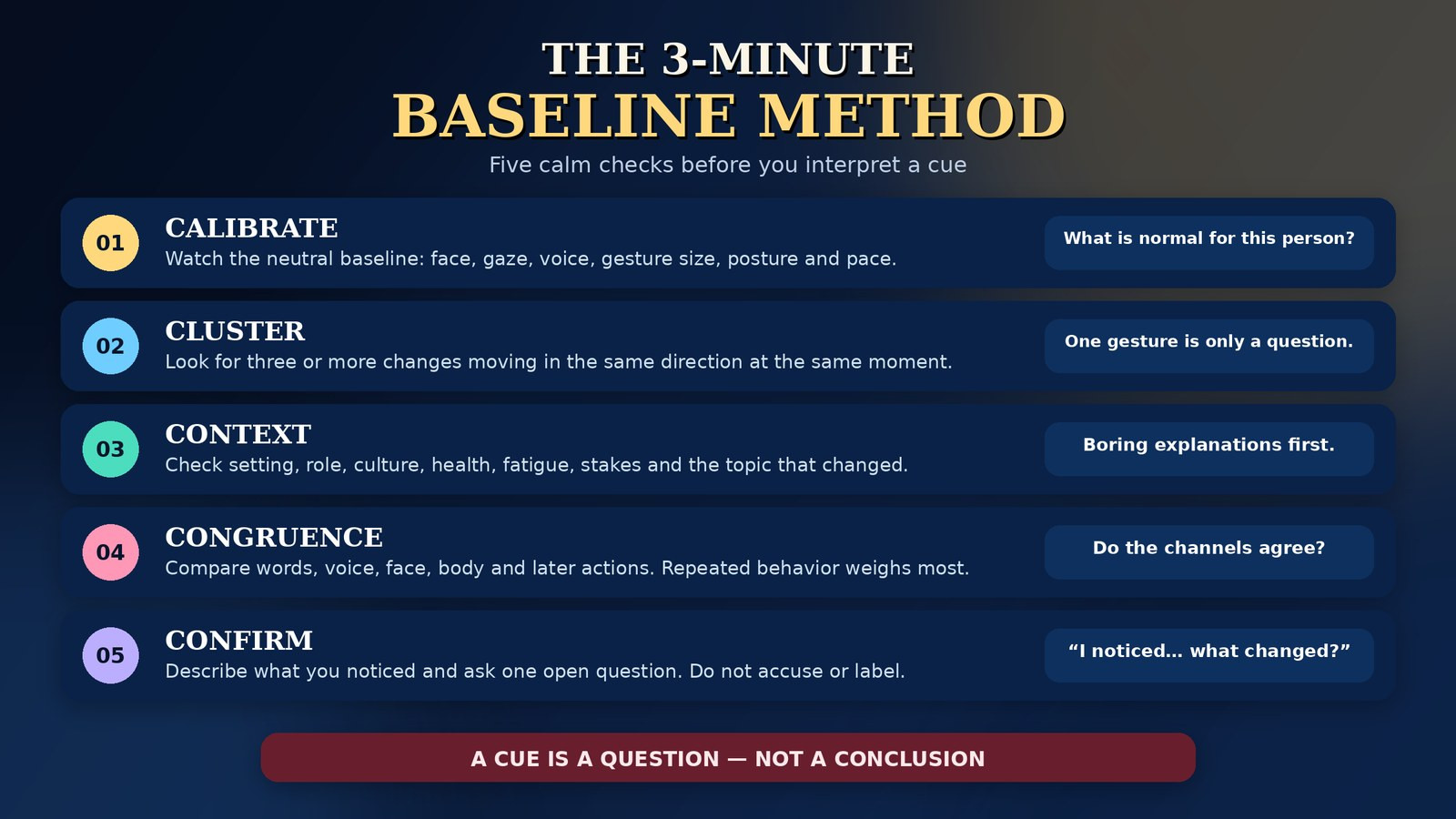
Figure: The 3-minute baseline method—calibrate, cluster, check context, compare congruence and confirm with a question.
Minute 1: Calibrate during neutral talk
Use arrivals, introductions or harmless small talk. Silently notice:
- Typical gaze pattern—not whether it matches your preference, but what is usual for them
- Facial movement and resting tension
- Voice pace, pauses, volume and answer length
- Gesture size, hand placement and self-touch habits
- Posture, preferred distance and how much they move
- How they listen: nodding, verbal acknowledgements, questions or quiet attention
Minute 2: Watch the whole system
Now widen your attention. Do not stare at one hand or keep score of every blink; that makes you miss the conversation. Ask whether the channels broadly move together. A person may be naturally still but verbally warm, or physically animated while saying very little. Normal is personal.
Minute 3: Mark the change point
When the real topic begins, note the exact moment any shift occurs. Did the change begin at a date, price, name, request, criticism or new person entering? Timing is often more informative than the cue itself.
| Channel | Baseline note | Change to watch later |
|---|
| Face | Relaxed mouth; brows rise when asking questions. | Jaw tightens; smile disappears; brows stay lowered. |
| Gaze | Looks away while thinking, returns to speaker to answer. | Stops returning gaze; repeatedly checks phone/exit. |
| Voice | Moderate pace; full sentences; natural pauses. | Speeds up, becomes clipped, or answers shrink sharply. |
| Hands | Uses medium gestures; pen held still. | Gestures vanish or object fiddling suddenly increases. |
| Posture | Sits angled toward group; shifts often for comfort. | Turns away, creates distance and remains unusually still. |
| Participation | Asks clarifying questions; builds on others. | Stops asking, interrupts, or agrees too quickly without detail. |
No baseline? Label your confidence low. Use the first minutes to listen, compare changes within the meeting, and rely more heavily on words, facts and follow-through.
The five checks in detail
- Calibrate: “What is normal for this person in this setting?”
- Cluster: “What changed together, and exactly when?”
- Context: “What ordinary cause could explain this?”
- Congruence: “Do words, voice, body and subsequent actions agree?”
- Confirm: “What respectful question would test my best hypothesis?”
That final question is the difference between people reading and people labeling. It also improves the conversation even when your first hypothesis is wrong.
25 common body-language signs decoded responsibly
Use the tables below as a hypothesis generator, not a dictionary. The important word in every row is change. A sign that is normal for someone at baseline tells you very little. A sudden cluster at a meaningful moment deserves a question.
Face signs 1–5
| # | Change you notice | Possible hypotheses | Do not conclude / better check |
|---|
| 1 | Brows lower or knit together | Concentration, confusion, concern, displeasure, bright light or effort to hear/see. | Do not assume anger. Ask, “Did that part land clearly, or should I rephrase it?” |
| 2 | Jaw, lips or mouth tighten | Tension, restraint, pain, concentration, holding back a response or dental discomfort. | Do not call it hidden rage. Slow down: “What feels unresolved here?” |
| 3 | A smile appears or disappears abruptly | Politeness, relief, embarrassment, social smoothing, discomfort or a genuine mood shift. | A smile is not proof of agreement. Check the decision in words: “Are you comfortable with that?” |
| 4 | Nose or upper-lip movement | Dislike of an idea/smell, concentration, nasal irritation or a fleeting reaction. | Do not declare disgust or contempt. Ask about the specific proposal, not the face. |
| 5 | Repeated sighing or yawning | Fatigue, boredom, stress release, room conditions, illness or a natural breathing reset. | Do not take it as automatic disrespect. Offer a pause or ask whether to shorten the discussion. |
Eye and gaze signs 6–9
| # | Change you notice | Possible hypotheses | Do not conclude / better check |
|---|
| 6 | Gaze breaks or stops returning | Thinking, remembering, reading, cultural respect, overload, distraction or reduced engagement. | Looking away does not prove lying. Say, “Take your time—what are you weighing up?” |
| 7 | Unusually fixed or intense stare | Deep listening, challenge, surprise, trying to appear credible, vision/hearing effort or social style. | Steady gaze does not prove honesty or attraction. Judge content, consent and follow-through. |
| 8 | Blink pattern changes noticeably | Cognitive effort, dry eyes, light, contacts, stress, fatigue or a change in attention. | Never use blink rate as a deception test. Compare only with that person’s baseline and look for a cluster. |
| 9 | Pupils look larger or smaller | Lighting, focus distance, arousal, effort, medication, substances or eye conditions. | Pupils do not decode love or lies. In normal conversation, ignore them unless there is a medical/safety concern. |
Voice signs 10–13
| # | Change you notice | Possible hypotheses | Do not conclude / better check |
|---|
| 10 | Speech pace speeds up or slows down | Excitement, urgency, anxiety, emphasis, careful wording, fatigue or trying to finish. | Fast speech is not proof of deception. Ask one question at a time and let the answer finish. |
| 11 | Pitch or volume shifts | Emotion, emphasis, room noise, authority display, hearing needs or vocal habit. | A louder voice is not automatically aggression; a quiet voice is not weakness. Check impact and content. |
| 12 | Pauses, fillers or restarts increase | Thinking, memory search, emotion, language load, carefulness, distraction or uncertainty. | “Um” is not a lie detector. Ask for a timeline or example if accuracy matters. |
| 13 | Answers become much shorter or much longer | Closure, overload, guardedness, enthusiasm, over-explaining, confusion or time pressure. | Length alone proves neither guilt nor interest. Summarize what you heard and ask what is missing. |
Hand and gesture signs 14–17
| # | Change you notice | Possible hypotheses | Do not conclude / better check |
|---|
| 14 | Self-touch or fidgeting increases | Self-regulation, energy, habit, discomfort, pain, temperature or concentration. | Face-touching does not expose a liar. Notice whether it began at a specific topic and ask about that topic. |
| 15 | Gestures grow larger or suddenly shrink | Emphasis, enthusiasm, restraint, formality, fatigue or adapting to space/camera. | Big gestures do not prove confidence; still hands do not prove concealment. Compare with baseline. |
| 16 | Hands disappear into pockets, sleeves or under the table | Cold, comfort, habit, clothing, cultural formality, holding an object or reduced engagement. | Hidden hands do not mean hidden motives. Look at participation and actions instead. |
| 17 | An object is clutched, tapped or placed as a barrier | Focus aid, habit, note-taking, self-soothing, boundary-setting or simple convenience. | A bag, cushion or laptop is not automatic rejection. Offer space and watch whether engagement returns. |
Posture and movement signs 18–21
| # | Change you notice | Possible hypotheses | Do not conclude / better check |
|---|
| 18 | Leaning in or pulling back | Interest, hearing difficulty, intimacy norms, surprise, boundary, chair comfort or a wish to see materials. | Leaning in is not consent; leaning back is not rejection. Ask about comfort or continue based on words. |
| 19 | Torso, head or feet turn away | Attention moved, preparing to leave, addressing someone else, discomfort, seating angle or distraction. | Feet are not secret truth arrows. Check time and priority: “Do we need to wrap up?” |
| 20 | Arms or legs cross; posture closes | Cold, comfort, concentration, habit, self-support, disagreement or a desire for space. | Do not diagnose defensiveness. Read temperature, chair, baseline and whether participation changes. |
| 21 | Unusual stillness or restlessness | Attention, tension, pain, energy, fatigue, excitement or trying not to interrupt. | Stillness can be listening; movement can be normal regulation. Do not moralize either pattern. |
Space, synchrony and action signs 22–25
| # | Change you notice | Possible hypotheses | Do not conclude / better check |
|---|
| 22 | Distance increases or decreases | Culture, relationship, noise, privacy, safety, status, mobility or room layout. | Never chase someone who steps back. Restore comfortable distance and let them control approach. |
| 23 | Posture, pace or wording starts to mirror | Rapport, shared training/culture, deliberate sales technique, empathy or coincidence. | Mirroring does not prove attraction or sincerity. Watch consistency when saying no would be costly. |
| 24 | Touch begins, increases or stops | Greeting norms, reassurance, celebration, dominance, care, accident or a changed boundary. | Touch never replaces explicit consent. If someone stiffens or withdraws, stop and give space. |
| 25 | Timing and follow-through change repeatedly | Workload, priority, avoidance, reliability problem, power, forgetfulness or a developing pattern. | One late reply is weak evidence. Repeated missed commitments are actionable facts—address the pattern. |
The strongest item in the list is #25. A gesture lasts a second. Repeated choices reveal priorities. If sweet words are followed by chronic lateness, broken agreements and no repair, believe the pattern. If an awkward communicator consistently shows up, tells the truth and fixes mistakes, do not punish them for imperfect eye contact.
What do crossed arms really mean?
Crossed arms are the world’s most over-interpreted gesture. They can accompany disagreement, but they also solve ordinary physical problems: the room is cold, the chair has no armrests, a shoulder hurts, the person is concentrating, or folded arms are simply their resting posture.
| Scenario | Other signals | More careful read |
|---|
| Cold meeting room; person asks detailed questions and takes notes. | Warm tone, forward attention, active participation. | Probably comfort. Do not “call out” the arms. |
| Arms fold exactly when a deadline is announced. | Jaw tightens, torso turns away, answers become clipped. | The deadline may be the pressure point. Ask about feasibility. |
| Arms were folded from the first minute. | No change across easy and difficult topics. | Likely baseline or seating. Almost no diagnostic value. |
| Arms fold while the person steps back and says, “I am not comfortable.” | Words and distance agree. | Respect the boundary. The explicit words outrank your interpretation. |
The same logic applies to crossed legs, hands in pockets and a turned foot. Start with physics and baseline before psychology.
Can body language show attraction?
Sometimes attraction travels with attention: a person chooses proximity, orients toward you, prolongs the conversation, asks personal questions, remembers details and creates safe chances to meet again. But friendliness, professional warmth, politeness, curiosity and cultural style can look similar. Eye contact, smiling, hair movement, touching an arm or “open” posture cannot establish romantic interest on their own.
| Weaker evidence | Stronger evidence | What to do |
|---|
| One long look, a smile, laughing at a joke, standing close in a crowded place. | Repeated voluntary time, reciprocal questions, remembering details and accepting a clearly optional invitation. | Make one respectful, easy-to-decline invitation. Accept ambiguity or “no” gracefully. |
| Compliments from a server, salesperson, teacher or colleague doing their job. | Interest expressed outside a paid/professional duty, with no power pressure and consistent follow-through. | Do not treat customer-service warmth as a personal signal. |
| Touch during a photo, greeting, dance class or crowded train. | Explicit words plus enthusiastic agreement to the specific next step. | Body language never substitutes for consent. Ask; do not decode permission. |
Boundary rule: If someone moves away, becomes still, gives short answers, avoids plans or says no, stop escalating. Do not search for a secret cue that overrides a visible boundary.
What about confidence?
Upright posture, steady speech and comfortable movement can create an impression of confidence, but impressions are not competence. A nervous expert may fidget. A confident performer may be wrong. For decisions that matter—hiring, investing, medical care, safety or trust with money—use track record, work samples, references and verifiable facts. Body language may tell you to slow down and ask another question; it should not become the selection test.
Can body language prove someone is lying?
No. There is no reliable “Pinocchio cue”—no eye movement, nose touch, blink pattern, posture or microexpression that separates liars from truthful people in ordinary life.
The research is humbling. DePaulo and colleagues combined 1,338 estimates covering 158 possible cues to deception; many behaviors showed no link or only weak links to deceit. You can inspect the abstract at PubMed. A later meta-analysis by Bond and DePaulo synthesized 206 documents and 24,483 judges: people averaged about 54% correct lie–truth judgments in real time—only slightly above 50% chance in a balanced test, correctly identifying 47% of lies and 61% of truths. See Accuracy of Deception Judgments.
Why nervousness is a bad lie detector
- An honest person may be nervous because the stakes are high or they fear not being believed.
- A practiced liar may be calm, warm and fluent.
- Memory is reconstructive: an honest account can contain gaps or corrections.
- Stress, trauma, disability, language load and power imbalance can all change behavior.
- Your suspicion can make you notice only the cues that fit it.
A better truth-checking method
| Step | Move | What to do | Example |
|---|
| 1 | Start open | Let the person give an uninterrupted account before you challenge details. | “Walk me through what happened from the beginning.” |
| 2 | Build a timeline | Separate sequence, memory gaps, assumptions and directly observed facts. | “Which parts did you see yourself, and which did someone tell you?” |
| 3 | Ask for verifiable anchors | Dates, messages, receipts, locations, documents or named witnesses that can be checked fairly. | “Which email confirmed that date?” |
| 4 | Compare independent evidence | Check records before deciding whether an inconsistency is deception, error or misunderstanding. | “The invoice says Tuesday; help me reconcile that with Thursday.” |
| 5 | Decide on evidence and risk | You may pause, insure, document or decline a deal without proving someone’s inner intent. | “I am not comfortable proceeding until the record is clear.” |
Do not use body-language suspicion to interrogate a child, employee, partner, patient or suspect. In legal, medical, safeguarding or employment matters, use qualified processes and evidence. A wrong accusation can damage trust and make an honest person behave exactly like your stereotype of a liar.
7 body-language myths to stop repeating
| # | Myth | What to believe instead |
|---|
| 1 | “93% of communication is nonverbal.” | The famous 7–38–55 figures came from narrow experiments about feelings/attitudes when cues conflicted. Albert Mehrabian himself warns they do not apply to communication in general. Facts, instructions and stories plainly depend on words. See Mehrabian’s clarification. |
| 2 | “Liars avoid eye contact.” | Gaze varies with thought, culture, status, fatigue, sensory needs and deliberate impression management. Some liars overdo eye contact because they know the stereotype. |
| 3 | “Crossed arms always mean defensiveness.” | Temperature, seating, habit, pain and concentration are common explanations. Only a baseline change plus a cluster deserves exploration. |
| 4 | “Microexpressions turn you into a human lie detector.” | Brief facial movements exist, but spotting one does not identify its cause—and deception research does not support movie-level certainty. Context and evidence still rule. |
| 5 | “Looking up-left means remembering; up-right means inventing.” | This popular eye-direction claim is not a reliable truth test. Do not use gaze direction to judge memory or fabrication. |
| 6 | “Dilated pupils mean attraction or deception.” | Light is the first explanation, followed by focus, effort, medication and eye conditions. Pupil reading is impractical and unsafe as a social verdict. |
| 7 | “Confident body language means a competent, honest person.” | Confidence can be performed, and anxiety can accompany expertise. Judge claims, work quality, records, references and repeated follow-through. |
Manipulation: read patterns, not gestures
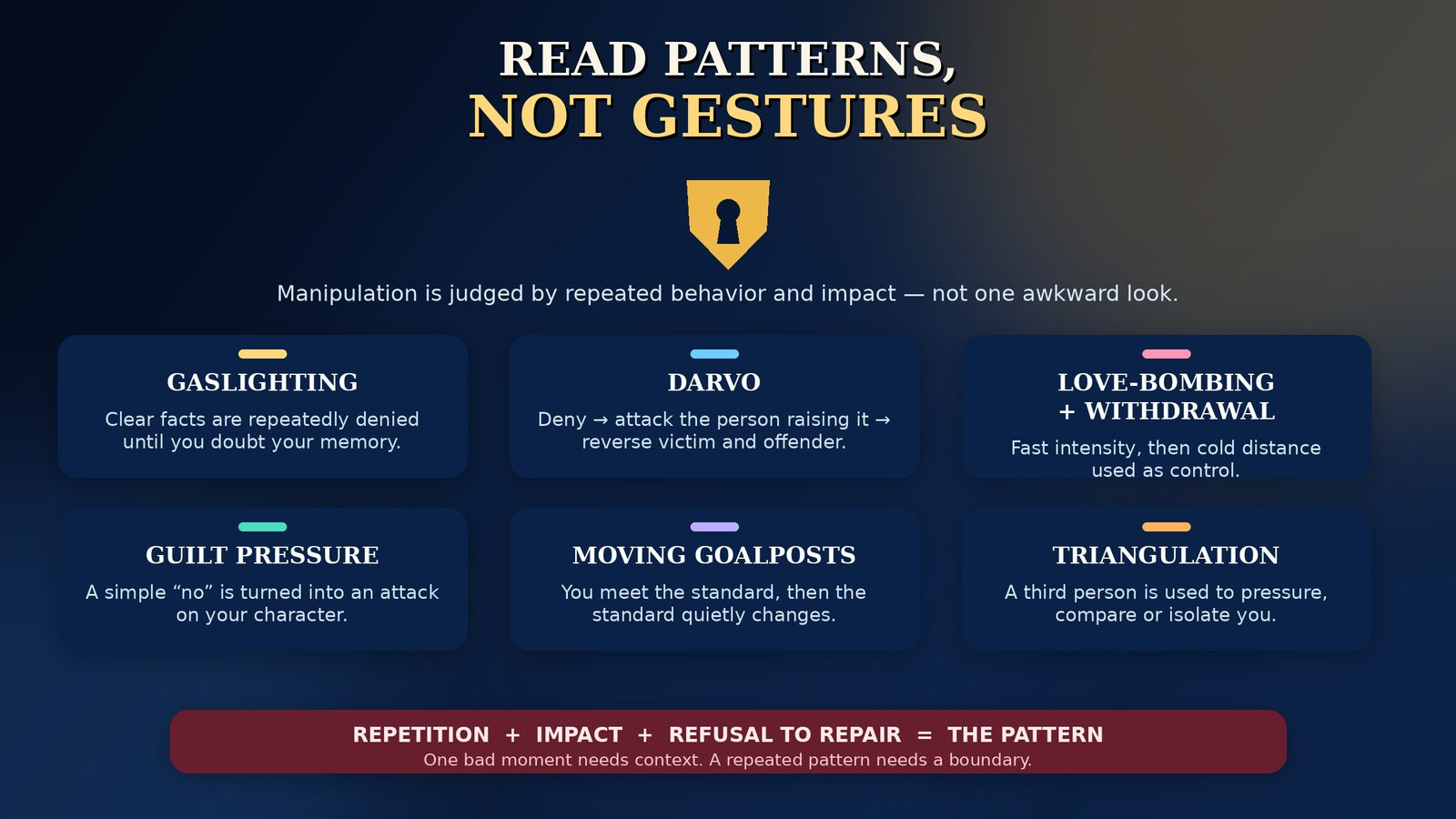
Manipulation is not “someone looked away while disagreeing with me.” Ordinary people can be awkward, defensive, forgetful or overwhelmed. A manipulative pattern is better judged by repetition, impact and what happens when you ask for accountability.
Figure: Manipulation is a repeated behavior pattern with impact—not a single awkward gesture.
The accountability test
Use this only when a direct conversation is safe. If there is intimidation, stalking, coercion or violence, prioritize a safety plan and specialist support over testing the pattern.
- Describe one observable behavior and its impact.
- Make one clear, reasonable request.
- Watch whether the person acknowledges, clarifies and repairs—or repeatedly denies, attacks, changes the subject and makes you the problem.
- Judge the repeated response over time. One heated moment is context; a consistent refusal to repair is data.
| Pattern | What it can look like over time | Calm response that stays on behavior |
|---|
| Gaslighting | Clear events or agreements are repeatedly denied until you doubt your memory or perception. | “I am going by the dated message. Let’s put the next agreement in writing.” See the National Domestic Violence Hotline’s gaslighting explainer. |
| DARVO | Deny the behavior, attack the person raising it, then reverse victim and offender roles. | “I hear you feel hurt. Right now I need an answer about the missed deadline.” Background: Jennifer Freyd on DARVO. |
| Love-bombing, then withdrawal | Intense praise, speed and promises early on, followed by coldness or punishment when you set a limit. | “This pace is too fast for me. I need time, and I will judge consistency over time.” |
| Guilt pressure | Your boundary is reframed as selfishness, disloyalty or lack of love rather than answered directly. | “I understand you are disappointed. My answer is still no.” |
| Silent treatment / stonewalling | Communication is repeatedly withheld to punish or control, not as a brief agreed cool-down. | “I can pause for 30 minutes, but I need a time when we will finish this.” |
| Moving goalposts | You meet a stated standard, then a new standard appears and the original effort is dismissed. | “Please confirm the success criteria in writing before I revise it again.” |
| Triangulation | A third person is quoted, compared or recruited to pressure you instead of direct communication. | “I will discuss this directly with you. I am not deciding based on unnamed opinions.” |
| False urgency / isolation | “Decide now, tell no one” pressure blocks advice, evidence and reflection. | “I do not make pressured decisions. Send the details; I will review them independently.” |
Safety note: Do not try to “win” a pattern that involves threats, stalking, coercion, violence or fear. Preserve important records where safe, tell a trusted person, and seek local emergency or specialist support. You do not need to diagnose narcissism or prove a label before protecting yourself.
Seven shield sentences
- “I need time to think before I decide.”
- “Please put that in writing.”
- “Let us return to the original question.”
- “I hear your feeling; the agreement still needs an answer.”
- “That does not work for me.”
- “If the shouting continues, I will end this conversation and revisit it at 6 p.m.”
- “I am not available for pressure, threats or insults.”
A boundary is not a spell that controls another person. It is a clear statement of what you will do next. The follow-through is what gives it weight.
Reading body language at work, on dates and on video calls
| Setting | Useful change to notice | Common traps | Better move |
|---|
| Job interview | Energy or answer length changes at a topic; confusion cluster after a question. | Treating nerves, gaze style, handshake or fidgeting as competence evidence. | Use structured questions and work samples. Clarify; do not score “confidence vibes.” |
| Meeting / presentation | Several people exchange glances, stop taking notes or become unusually quiet. | Assuming silence means agreement or boredom. | Pause and ask, “What is unclear or risky in this plan?” Invite written input. |
| Negotiation / sales | Cluster shift at price, term, deadline or authority; rushed agreement without detail. | Reading a pause as weakness or a smile as acceptance. | Summarize terms, ask about constraints and confirm in writing. |
| Dating / relationships | Reciprocity, relaxed participation, voluntary time and response to boundaries. | Decoding politeness, touch or pupil size as desire. | Ask clearly, make refusal easy and let repeated choices speak. |
| Friendship / family | Withdrawal from baseline, shorter replies or repeated cancellation pattern. | Mind-reading rejection and retaliating before asking. | “I have noticed we have missed each other lately. Is everything okay?” |
| Video call | Voice, participation and facial changes; repeated multitasking at a topic. | Camera angle, lag, looking at notes/chat, cropped hands and poor lighting. | Use names, explicit check-ins and chat/documents. Do not demand constant camera gaze. |
| Text / chat | Pattern of clarity, respect, follow-through and repair over time. | Treating response speed, punctuation or one short message as body language. | Ask for the missing fact. Move important agreements into a clear written summary. |
Questions that check your read without accusing
Use this formula: neutral observation + ownership + open question. Ownership means admitting your read may be wrong.
“I may be misreading this, but the energy changed when we reached the timeline. What part is hardest?”
| Situation | Useful checking question |
|---|
| Possible confusion | “Which part should I explain differently?” |
| Possible disagreement | “What would you challenge first if this were your decision?” |
| Possible overload | “Would a pause help, or shall we reduce this to the next step?” |
| Possible time pressure | “How much time do you realistically have for this now?” |
| Possible discomfort | “Is this topic okay to discuss here, or would another setting be better?” |
| Possible hidden constraint | “What am I not seeing that makes this difficult?” |
| Rushed agreement | “Before we lock it, what could make this fail?” |
| Emotional shift | “Something seemed to change there. What came up for you?” |
| Boundary check | “Would you like more space, a break, or to stop here?” |
| Fact check | “Can we identify the document or message that settles that point?” |
After asking, actually listen. Paraphrase the answer in your own words, ask whether you understood it correctly, and update your hypothesis. A checking question is not a trap; it is an invitation to correct you.
Improve your own body language
The goal is congruence, not performance. People usually trust a calm match between your words, voice, movement and follow-through more than a rehearsed “power pose.”
| Principle | Helpful behavior | Avoid |
|---|
| Make listening visible | Put the phone away, let sentences finish, paraphrase and ask relevant follow-up questions. | Mechanical nodding while planning your reply or staring without responding. |
| Use comfortable orientation | Angle toward the speaker, leave an easy exit/distance and adjust to the setting. | Cornering, looming, chasing someone who steps back or demanding eye contact. |
| Let gestures support words | Gesture naturally for size, sequence and emphasis; slow down at key points. | Copying every movement or freezing yourself into an unnatural statue. |
| Match voice to message | Use enough volume for the room, pause between ideas and land important sentences. | Rushing bad news, shouting for authority or hiding a decision in a long monologue. |
| Repair quickly | If you interrupt, crowd or misunderstand, name it and correct it: “I cut you off—please finish.” | Defending your intention while ignoring the impact. |
| Close with an action | Summarize, agree the next step and then do it. Follow-through is body language over time. | Warm signals in the room followed by silence, delay or broken commitments. |
On camera
- Raise the camera near eye level and look at the speaker’s window while listening; glance at the lens for key points.
- Keep enough distance for natural head and hand movement to remain visible.
- Reduce lag confusion by naming turns: “Sam, after you, I will add the date.”
- Do not punish people for looking at notes, captions, a second screen or away from the lens.
Bias, culture, disability and ethics
Your eyes do not deliver raw truth. They deliver evidence filtered through expectation. The most dangerous body-language reader is not the beginner—it is the confident person who stops checking.
| Risk | How it distorts your read | Guardrail |
|---|
| Confirmation bias | You notice cues that fit suspicion and ignore calm or contradictory behavior. | Write two innocent explanations before you act. |
| Halo / horns effect | Attractive, fluent or high-status people seem honest; awkward people seem suspicious. | Separate delivery from evidence, competence and track record. |
| Cultural mismatch | Gaze, distance, touch, silence, expressiveness and gestures carry different local norms. | Learn the setting, watch baseline and ask rather than imposing your norm. |
| Disability and neurodivergence | Eye contact, movement, facial expression, speech timing or sensory behavior may differ without any hidden motive. | Never use a cue checklist to diagnose. Make communication accessible and judge explicit behavior fairly. |
| Health and state | Pain, fatigue, grief, medication, trauma, hunger or illness can mimic disengagement or tension. | Put state explanations in the hypothesis list every time. |
| Power imbalance | A junior employee, student, patient or child may freeze, appease or become quiet because consequences are unequal. | Reduce pressure, offer written/private channels and do not treat compliance as consent. |
| Gender and age stereotypes | The same assertiveness, emotion or stillness may be judged differently depending on who displays it. | Describe the exact behavior and apply the same standard to everyone. |
The Observer’s Oath
- I will describe behavior before interpreting it.
- I will compare a person with their own baseline, not with my preferred style.
- I will let explicit words and boundaries outrank my guess.
- I will use observation to ask kinder, clearer questions—not to control people.
- I will judge harm by repeated behavior and repair, not by a diagnosis I invented.
Worked examples: from cue to better question
| Scenario | Observation + timing | Possible explanations | Better next move |
|---|
| The budget meeting | A usually talkative manager folds arms, stops gesturing and gives one-word answers when a two-week deadline appears. | Deadline impossible, missing staff, disagreement, fatigue or an unrelated problem. | “The concern may be feasibility. Which resource is missing?” Discuss dates, not arms. |
| The warm first date | Your date smiles and leans in, but repeatedly checks the time and declines a second drink. | Enjoying the conversation, tired, transport deadline, politeness or mixed interest. | “I have enjoyed this. Would you like to meet again, or shall we leave it here?” Accept the answer. |
| The pressured purchase | A seller becomes warm and mirrored, then says the discount disappears unless you sign without reading. | Sales style or deliberate urgency; the request itself prevents verification. | “Send the written offer. I will review it independently.” Judge the pressure tactic, not the smile. |
| The silent partner | After you mention a missed bill, replies stop for two days. Similar shutdowns happen whenever accountability is raised. | Overwhelm, avoidance, conflict style or punitive silence. | Propose a defined pause and return time. If repair repeatedly fails, address the pattern and seek support. |
| The nervous expert | An interview candidate looks away while calculating, taps a pen and gives a precise, well-evidenced answer. | Cognitive effort, normal regulation or interview stress. | Score the work sample and reasoning. Do not subtract points for a gaze stereotype. |
A 7-day starter practice and 30-day pathway
Practice observation in low-stakes settings. Do not secretly test people, record them without permission or turn family dinners into interrogations. The aim is attention plus humility.
| Day | Practice | Success marker |
|---|
| Day 1 | Notice your own baseline in a routine call: pace, gestures, gaze and posture. | You can describe behavior without judging yourself. |
| Day 2 | In a public talk or video, identify the speaker’s neutral range before the difficult section. | You wait for a baseline before interpreting. |
| Day 3 | Spot one change point and name the topic that triggered it. | You track timing, not isolated poses. |
| Day 4 | For one cluster, write three explanations: emotional, physical and contextual. | Your first guess stops feeling like a fact. |
| Day 5 | Use one neutral checking question in a real conversation. | You ask instead of accusing. |
| Day 6 | Review a past misunderstanding: separate observation, hypothesis and evidence. | You can see where certainty outran data. |
| Day 7 | Focus on follow-through: one promise kept, missed or repaired. | You weigh repeated action more than performance. |
| Week | 30-day pathway |
|---|
| Week 1 | Baselines only. Learn normal ranges for voice, face, hands and participation. |
| Week 2 | Clusters and change points. Stop recording single gestures. |
| Week 3 | Context and congruence. Compare words, channels and later actions. |
| Week 4 | Checking questions, feedback and boundaries. Review where your reads were wrong and why. |
Go deeper with The People Code
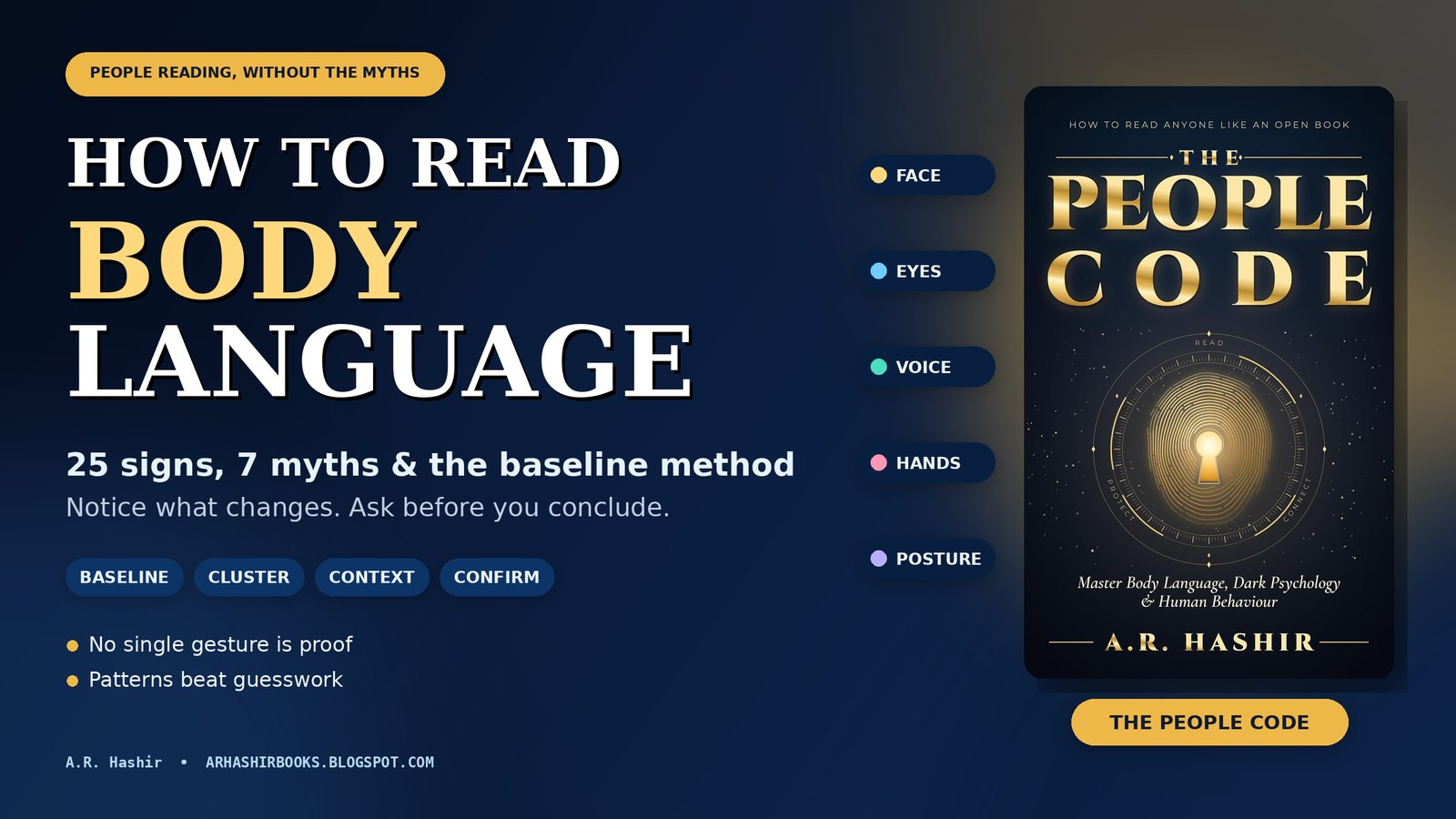
This article gives you the safety rails: baseline, cluster, context, congruence and a checking question. In The People Code: How to Read Anyone Like an Open Book, I turn that discipline into a fuller practice system for everyday conversations, work and relationships.
The 237-page book is built around a simple rule: understand to connect, never to control. It develops observation across face, eyes, body and voice; introduces the 3-Minute OPEN baseline method; covers listening, clear feedback and trust; and separates ordinary conflict from manipulation patterns such as gaslighting and DARVO. Practical tools include 20 scenarios, a 50-signals quick reference, nine workbook sheets, seven shield responses, a 30-day people-reading plan and a 70-term glossary.
| Book detail | What to check on Amazon |
|---|
| Formats | Kindle, paperback and hardcover editions are listed on Amazon.com. Current price and availability can change, so use the live product page rather than a screenshot. |
| Best for | Readers who want a structured people-reading practice without mind-reading claims, plus communication and manipulation-defense tools. |
| Not a substitute for | Clinical assessment, safeguarding, legal investigation, lie detection or emergency/safety support. |
Read the Sample / View The People Code on Amazon →
Also available as paperback and hardcover. Browse the full catalogue on the Books by A.R. Hashir on Amazon page.
Frequently asked questions
Can you really read someone’s mind through body language?
No. You can sometimes infer attention, effort, comfort or a likely pressure point, especially from a baseline change and a cluster. You cannot access exact thoughts or motives from a gesture.
What is the easiest body language to read?
Large, repeated changes in participation are usually more useful than tiny facial movements: someone stops asking questions, answers shrink, they turn away and create distance at a specific topic. Even then, ask rather than conclude.
What are the five main body-language channels?
A practical shortlist is face, gaze, voice, hands/gestures and posture/orientation. Add space, touch, timing and follow-through for a fuller picture.
Does avoiding eye contact mean someone is lying?
No. People look away to think, remember, read, manage sensory load, show respect or reduce intensity. Truth should be checked with timelines and evidence.
What does crossed arms mean?
It may mean cold, comfort, concentration, habit, pain, disagreement or a need for space. Compare the room, chair, baseline and cluster. It is not a reliable stand-alone sign of defensiveness.
Can body language show that someone likes you?
Repeated voluntary attention, reciprocal conversation and follow-through are stronger than looks or touch. Still, only clear communication can establish interest, and body language never establishes consent.
What percentage of communication is body language?
There is no universal percentage. The often-quoted 93% or 7–38–55 claim is a misapplication of narrow feelings/attitude experiments. Words carry the specific content of most messages; voice and body can alter how that content is received.
How long does it take to learn body language?
You can learn the baseline–cluster–context habit in a week, but calibration takes longer because you must notice when your guesses are wrong. A month of low-stakes practice and feedback is a realistic foundation.
What is the difference between manipulation and awkward communication?
Awkwardness is usually inconsistent and can respond to clarity, time or repair. Manipulation is judged by a repeated pattern that pressures, confuses or controls—especially when accountability consistently triggers denial, attack or punishment.
Should body language be used in hiring or investigations?
Not as decisive evidence. It is too vulnerable to culture, disability, stress and bias. Use structured questions, work samples, records, references and fair professional processes.
Sources and further reading
- Barrett, L. F., Adolphs, R., Marsella, S., Martinez, A. M., & Pollak, S. D. (2019). “Emotional Expressions Reconsidered: Challenges to Inferring Emotion From Human Facial Movements.” Psychological Science in the Public Interest.
- DePaulo, B. M., et al. (2003). “Cues to Deception.” Psychological Bulletin.
- Bond, C. F., Jr., & DePaulo, B. M. (2006). “Accuracy of Deception Judgments.” Personality and Social Psychology Review.
- Albert Mehrabian. Clarification of the verbal/nonverbal equations and their limited feelings-and-attitudes context.
- Jennifer J. Freyd DARVO explainer.
- National Domestic Violence Hotline. “What Is Gaslighting?”
- Non-verbal communication channels overview: “Non-verbal communication questionnaire: a measure to assess effective interaction.”
Key takeaways
- Baseline beats a gesture dictionary. A change from normal matters more than a pose.
- Clusters beat single cues. Even a cluster is a hypothesis, not proof.
- Context beats pop psychology. Check room, role, culture, health, disability and stakes.
- Words and actions outrank vibes. Follow-through and repair reveal the pattern.
- Questions beat accusations. Describe what changed and invite the person to correct you.
- Patterns beat labels. You can set a boundary against repeated behavior without diagnosing a person.
Read people slowly enough to be fair, clearly enough to ask, and firmly enough to act on repeated behavior. That is the real people code.
About the author: A.R. Hashir writes practical guides on human behavior, artificial intelligence, digital visibility and product security. Explore the catalogue on Books by A.R. Hashir on Amazon.
Comments
Post a Comment
Thanks for joining the discussion. Please keep comments helpful and relevant. Comments are moderated, and promotional spam links will be removed.